
Hunting jackets for forestry contractors: complete 2026 guide
Forestry workers’ jacket selection is choosing outerwear for the task, weather and required protection, with the aim of staying dry without restricting safe movement. This 2026 guide separates everyday outdoor jackets from specialist workwear for contractors in Ireland.
- Choose outdoor jackets for forestry workers by task first; weather protection does not establish chainsaw protection.
- We sell outdoor clothing; specialist forestry PPE needs separate checks against your site requirements.
- Härkila Forest Hunter GTX Jacket is an outdoor clothing option, not an automatic choice for machinery work.
- Check movement, visibility, layering and garment instructions before choosing a jacket for an Irish forestry site.
Why jacket choice matters for forestry workers
A weatherproof jacket is not automatically suitable for forestry work. Walking a plantation, planting trees, operating machinery and working beside moving vehicles place different demands on clothing. Start with the job, not the jacket’s name.
In Ireland, you need to consider rain alongside physical effort. A warm coat that suits a stationary inspection can become uncomfortable during planting. A light shell that packs easily still needs to work with the protective equipment your task requires.
Our guide to waterproof jackets for hillwalking in Ireland covers general outdoor selection. For a forestry contract, add the employer’s risk assessment, site rules and required PPE before you make a shortlist.
We’re an outdoor shop for forestry workers choosing weather layers, not a substitute for specialist PPE advice. Outdoor clothing can meet everyday weather needs, but you must establish its suitability for the actual work separately.
Choose your forestry jacket in seven steps
Establish the task before comparing jackets
Use your current clothing first. Write down what works, where it restricts you and when you feel wet or overheated. That gives you a useful buying brief without purchasing anything.
Separate walking and surveying from tool use, machinery operation and roadside activity. Include time spent sitting in a cab or standing still. Your jacket must suit the whole task, not just the walk from the vehicle.
For your 2026 clothing review, confirm the required protection with the person responsible for site safety. Do not treat a woodland product name, tough-looking fabric or camouflage pattern as evidence of occupational protection.
- List the tasks you will perform while wearing the jacket.
- Record the protective equipment required for each task.
- Identify vehicle movements and visibility requirements.
- Note whether you work mainly on foot, seated or stationary.
- Separate weather clothing from equipment with a protective function.
Check protection labels before choosing fabric
Read the label and instructions on any jacket you already own. Then request the same information for a replacement. A waterproof claim describes weather performance; it does not establish protection against contact with a moving chainsaw.
EN ISO 20471 concerns high-visibility clothing. EN 343 concerns protection against rain. The EN ISO 11393 series concerns protective clothing for users of hand-held chainsaws. These standards address different hazards, and the relevant garment documentation matters more than a standard number in an advert.
Do not assume a green outdoor jacket meets a site’s visibility requirement. Equally, a bright colour alone does not establish high-visibility certification. Check the required garment type, its marking and the manufacturer’s intended use.
- Read the garment label and accompanying instructions.
- Match documented protection to the site’s risk assessment.
- Check visibility requirements before selecting a colour.
- Confirm whether an outer layer can cover required PPE.
- Reject undocumented protection claims.
Match weather protection to your working pace
Try changing how you use your existing layers before buying a heavier jacket. Remove unnecessary insulation during active work and carry a suitable extra layer for breaks. That helps distinguish a warmth problem from a ventilation problem.
An uninsulated waterproof shell is a useful starting point for active outdoor work when the task permits it. Separate insulation lets you adjust warmth. An insulated jacket suits colder, less active periods, but offers less flexibility when your effort rises.
We offer the Härkila Forest Hunter GTX Jacket as an outdoor clothing option. Its supplied description identifies an active forest and upland design with quiet, lightweight and durable material. Those details do not establish occupational certification, visibility compliance or suitability for machinery work.
- Choose warmth according to effort, not the season alone.
- Check the manufacturer’s weather-protection information.
- Inspect seam construction and zip protection.
- Check whether ventilation controls are accessible.
- Keep specialist protective requirements separate from comfort features.
Test movement with your full work kit
Put on your usual layers and permitted work equipment before checking fit. A jacket that feels roomy over a T-shirt can pull across the shoulders once you add insulation. Bigger is not automatically better: excess fabric can interfere with movement and equipment.
Use 4 movements as a practical fitting check: reach forward, raise your arms, bend and sit. These are fitting actions, not a safety certification test. Stop if the jacket catches on equipment, blocks a control or pulls tightly across your back.
For a 2026 replacement, check the same movements with the actual clothing combination you intend to wear. Never operate equipment simply to test a new jacket. Carry out fitting checks away from moving machinery.
- Reach forward without tightening the shoulders.
- Raise your arms and check sleeve and hem coverage.
- Bend without exposing your lower back.
- Sit and check whether the front bunches uncomfortably.
- Confirm that pockets and fastenings clear your equipment.
Build layers you can adjust
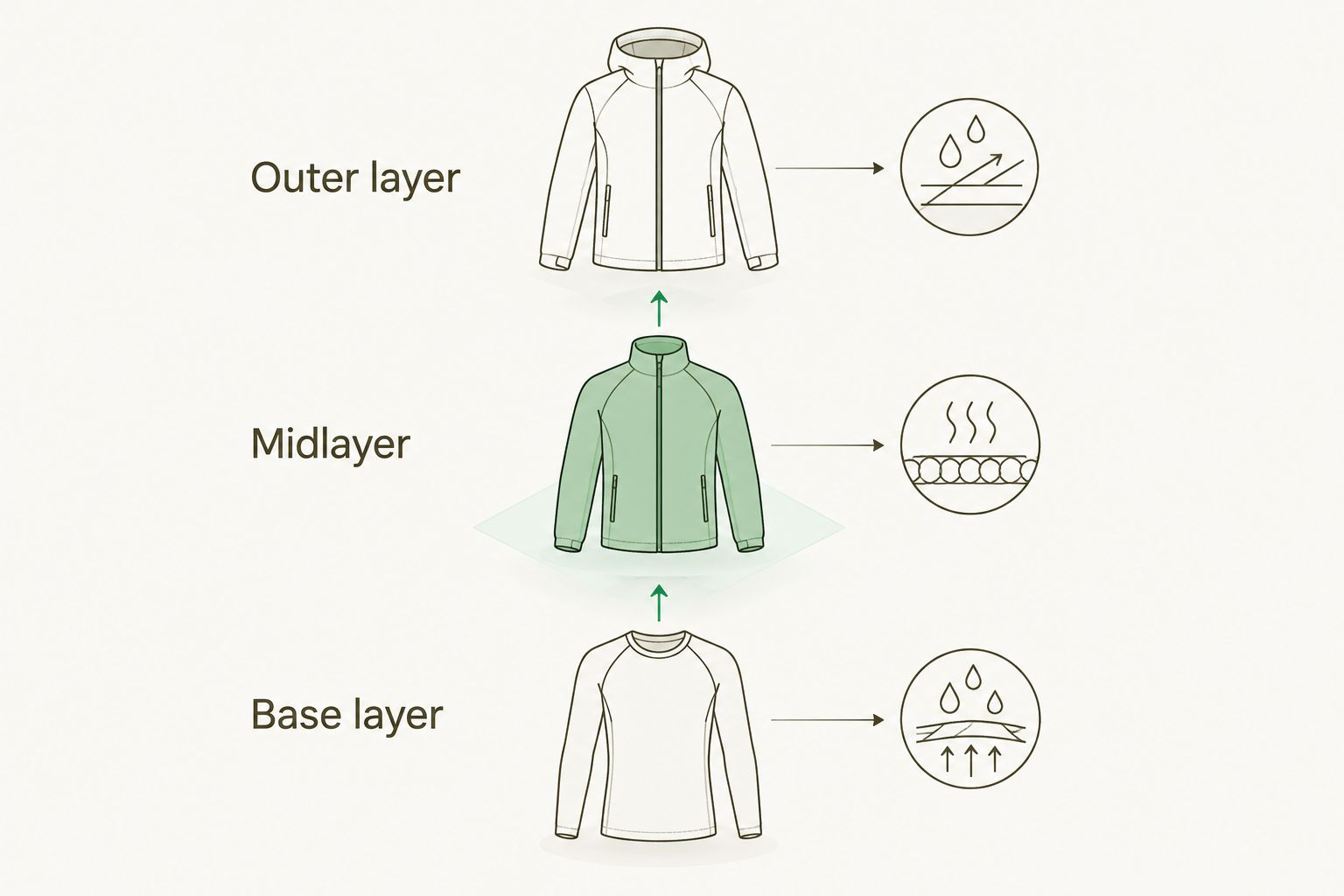
Start with garments you already have. A practical 3-layer approach separates a base layer, an insulating midlayer and an outer weather layer. This is a clothing arrangement, not a requirement to wear all three continuously.
Your base layer sits against the skin. Your midlayer adds warmth. Your outer layer handles the weather according to its stated performance. During hard work, reduce insulation rather than waiting until every layer feels damp.
Keep the clothing system compatible with required PPE. An extra outer jacket must not hide required high-visibility areas or interfere with protective equipment. Check those combinations with your employer or site safety lead.
- Fit the outer jacket over your normal midlayer.
- Remove unnecessary insulation before strenuous work.
- Carry a dry replacement layer where practical.
- Keep spare clothing protected from rain.
- Recheck visibility whenever you add an outer garment.
Check cuffs, pockets and equipment access
Use your existing jacket to identify awkward details. Try its zip and pockets with your usual gloves. Check whether the cuffs close properly without making glove use difficult, and whether your normal equipment obstructs pocket access.
Choose features that solve a work problem. A large pocket is useful only if you can reach it and its contents do not obstruct movement. Carrying heavy tools in an ordinary jacket can also pull the garment out of position.
A hood needs particular care around helmets, hearing protection and visibility. Follow the instructions for your protective equipment. Do not assume a hood fits safely just because it stretches over a helmet.
- Operate the main zip while wearing gloves.
- Check cuff adjustment with your glove arrangement.
- Reach pockets while wearing your permitted equipment.
- Secure loose drawcords according to garment instructions.
- Check head movement and vision with any hood in use.
Set a cleaning and replacement routine
Read the care label before washing the jacket you have. Mud, damage and poor fastening function deserve attention before your next shift. Cleaning and reproofing are different jobs, and neither repairs a torn seam automatically.
For your 2026 kit routine, inspect the jacket after demanding work and follow its manufacturer’s care instructions. Keep a record of defects if the garment forms part of your work equipment. Refer protective garments to the responsible person rather than improvising a repair.
A second dry jacket is useful for rotation, but it does not need to duplicate every feature. Both garments still need to meet the requirements of the tasks for which you use them.
- Inspect seams, cuffs, elbows and closures.
- Empty pockets before washing.
- Follow the specified cleaning and drying method.
- Use reproofing products only where instructions permit them.
- Remove unsuitable or damaged protective garments from service.
Compare jacket options by task
Choose the clothing category before choosing the brand. The table separates comfort benefits from limitations. It does not certify any option for a forestry operation.
The Härkila Forest Hunter GTX Jacket belongs in an outdoor clothing shortlist, not automatically in a contractor’s PPE issue. Its forest-focused description helps explain the intended setting; it does not confirm suitability for your worksite.
| Option | Best for | Main benefit | Key limitation |
|---|---|---|---|
| Uninsulated waterproof shell | Active outdoor tasks where site rules permit ordinary weather clothing | Lets you change insulation separately | Provides little warmth without additional layers; protection depends on the garment |
| Insulated outdoor jacket | Cold, less active inspections and stationary periods where permitted | Combines warmth with an outer garment | Less flexible when workload and body heat increase |
| Softshell jacket | Active tasks in conditions suited to its stated weather performance | Combines mobility with light weather protection | Do not assume it provides sustained-rain protection |
| Certified high-visibility rainwear | Tasks requiring documented visibility and rain protection | Addresses those requirements when the correct garment is selected | Does not automatically provide chainsaw protection |
| Task-specific protective jacket | Work requiring documented protection for a defined hazard | Matches a protective function to the task | Weather performance and layering compatibility still need checking |
| Härkila Forest Hunter GTX Jacket | Assessing an outdoor jacket described for active forest and upland use | Supplied description identifies quiet, lightweight and durable material | Occupational certification and site suitability are not established by that description |
There is no single winner for every forestry contractor. The strongest choice is the garment that meets the task requirements and fits your complete clothing system. Reject any jacket that fails either check, regardless of its outdoor credentials.
Common mistakes forestry workers make
Treating outdoor design as protective certification
A jacket designed for woodland use is not automatically designed for forestry operations. Fabric strength, quietness and weather protection are separate from documented protection against a specific work hazard.
Check the intended use and certification before assigning the jacket to a task. Do not rely on the product name.
Choosing warmth for the coldest moment only
A contractor can move from active work to a stationary break while wearing the same clothing. Choosing a heavily insulated jacket for the break alone leaves fewer ways to adjust during strenuous activity.
Use separate layers where your work requirements allow them. Carry warmth for the stop rather than wearing every layer throughout the task.
Covering required visibility with a dark outer layer
An ordinary coat worn over high-visibility clothing can conceal the areas that make the clothing visible. Adding an outer layer changes the clothing arrangement, not just its warmth.
Check the full combination against site requirements. Do not assume exposed sleeves are enough.
Testing fit without gloves or work equipment
An empty jacket pocket and an uncovered wrist tell you little about the working fit. Gloves, midlayers and permitted equipment change how you reach closures and move your arms.
Repeat the fitting check with your actual kit. Keep the test away from operating machinery.
Packing a wet jacket away until the next shift
A jacket left wet and dirty is harder to inspect properly. You also lose the chance to identify a damaged closure or seam before you need it again.
Follow the care label, dry the garment as instructed and inspect it before reuse. Reproofing does not replace repair or protective-garment assessment.
FAQ
What’s the best jacket for forestry workers in Ireland?
The best jacket for a forestry worker is one that meets the task’s protection requirements and fits the complete clothing system. Choose ordinary outdoor weather clothing only where the risk assessment and site rules permit it.
Can I wear an outdoor jacket while using a chainsaw?
Do not assume an outdoor jacket is suitable for chainsaw work. Check the required PPE, garment documentation and layering instructions with the person responsible for site safety.
Is a waterproof shell better than an insulated jacket for planting?
A waterproof shell offers more control over insulation during active planting, where ordinary weather clothing is permitted. An insulated jacket offers less adjustment when your effort increases; both still need checking against site requirements.
Does a green forestry jacket count as high-visibility clothing?
A green jacket does not establish high-visibility compliance. Check the garment’s documented certification and the visibility requirements for your task and site.
Is the Härkila Forest Hunter GTX Jacket certified forestry PPE?
The supplied product description does not establish forestry PPE certification. It describes an outdoor jacket for active forest and upland use, so assess occupational suitability separately before using it for work.
How should I check a work jacket’s fit?
Check the jacket over your usual layers and with your permitted work equipment. Reach, raise your arms, bend and sit away from moving machinery, then check closures and pockets with gloves on.
How do I clean a waterproof forestry jacket?
Follow the jacket’s care label and manufacturer’s instructions. Inspect damage separately, and do not treat cleaning or reproofing as a repair to protective clothing.
One last thing
Before ordering a jacket for your 2026 work kit, put your current coat on with the layers and equipment you actually use. Check pocket access, sleeve movement and whether the outer garment hides required visibility.
That fitting check costs nothing and produces a clearer shortlist than choosing by appearance. We sell outdoor clothing; your task requirements decide whether a particular jacket belongs on the site.