

Is it legal to put a trail camera on private land in Ireland?
Yes. You can use a trail camera on private land in Ireland in 2026 if you have authority to install it and use it lawfully. Landowner permission does not give you unrestricted permission to record people: the camera’s view, purpose and handling of identifiable footage determine your privacy obligations. This guide covers the Republic of Ireland; Northern Ireland has a separate legal framework.
- Is it legal to use a trail camera in Ireland? Yes, subject to land permission and privacy obligations.
- Ireland’s Data Protection Commission treats identifiable images of people as personal data; private land is not an exemption.
- Keep wildlife cameras aimed away from roads, neighbouring homes and shared access routes.
- We recommend deciding the camera’s purpose and view before choosing equipment.
Is it legal to put a trail camera on private land in Ireland?
Yes, but permission to mount the camera and permission to process personal data are separate questions. A wildlife camera looking into your enclosed garden presents a different privacy situation from a camera recording workers, visitors or a public road.
Our guide to trail cameras for wildlife photography in Ireland covers the equipment side. Start with the intended location before choosing the camera.
| Camera placement | Useful purpose | Privacy limitation | First action |
|---|---|---|---|
| Enclosed domestic garden | Personal wildlife observation | Visitors and neighbouring property still need consideration | Keep the view inside your boundary |
| Privately owned woodland | Wildlife observation | Walkers or workers can enter the frame | Check access routes and likely human activity |
| Working farm entrance | Property security | Business-related recording can bring GDPR duties | Document the security need and recording area |
| Shared lane or roadside gate | Access monitoring | Recording beyond your domestic boundary affects the household exemption | Narrow the view and assess the lawful basis |
These examples are not automatic legal clearances. A camera inside your boundary can still record outside it, and land described as private can have shared access arrangements.
Why this matters
A motion trigger does not distinguish between a fox and a person. A camera installed for wildlife can capture a neighbour, contractor, delivery driver or vehicle registration that identifies someone.
For your 2026 setup, assess what the camera actually records, not just what you intend it to record. A wildlife purpose does not cancel privacy obligations when identifiable people enter the footage.
Land ownership also does not remove other people’s access rights. Check leases, shared entrances and rights of way before deciding that everyone appearing on camera is trespassing.
When does GDPR apply to a trail camera?
GDPR applies to processing personal data, including images that identify a person. A face is an obvious example, but clothing, location, a vehicle registration or other details can identify someone in context.
The household exemption covers processing carried out during a purely personal or household activity. It is not a blanket exemption for every camera on privately owned land.
A domestic camera recording beyond the property boundary into a public space falls outside that exemption. A camera used for a business, working farm or organised research project also needs its own assessment; do not assume domestic rules apply.
Where GDPR applies, address these points:
- Lawful basis: identify why processing people’s images is lawful.
- Necessity: explain why recording is needed for the stated purpose.
- Proportionality: limit the view and recording to what that purpose requires.
- Transparency: give people appropriate information about the recording.
- Security and retention: restrict access and delete footage when it is no longer needed.
Security recording often relies on legitimate interests rather than consent. That requires a real interest, a necessity assessment and a balance against the rights of people recorded. Calling footage “security footage” does not complete that assessment.
How do I set up a trail camera responsibly?
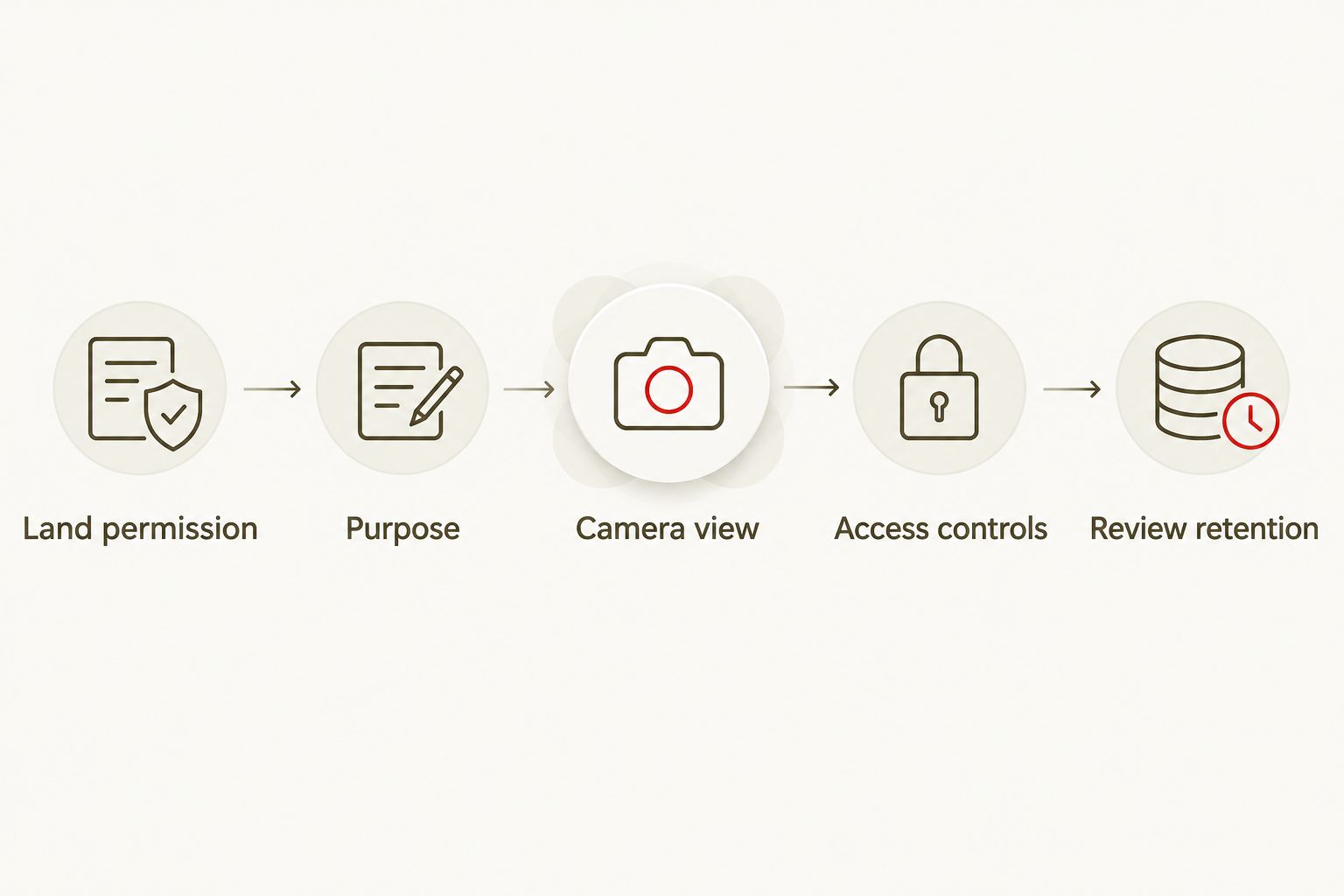
Use this sequence before leaving a camera running on private land in Ireland in 2026. It applies whether you are watching wildlife or assessing a security installation.
1. Confirm land permission
Check that you own the land or have permission from someone entitled to authorise the installation. If you rent, manage or share the property, check the relevant agreement rather than assuming access includes permission to attach equipment.
Record permission in writing when using someone else’s land. Describe the location, purpose, access arrangements and who will remove the camera.
2. Write down the purpose
Choose a clear purpose: observing wildlife in a particular area, or protecting a defined entrance or building. Avoid collecting footage simply because a camera has spare storage.
For private wildlife observation, we recommend a frame that excludes people and neighbouring property wherever practicable. If your purpose changes from wildlife observation to security monitoring, reassess the installation before continuing.
3. Check the camera view
Inspect test images from the final mounting position. Look for roads, windows, neighbouring gardens, shared paths and places where people stop or work.
Reposition the camera before relying on settings. Privacy masking helps only when the equipment supports it and the mask actually excludes the relevant area from recording.
4. Set access controls
Protect the camera account, phone and any storage service used for images. Give access only to people who need it, and remove access when that need ends.
For a connected camera, check where images go and who operates the service. A memory card, phone download and cloud copy are separate places where personal footage needs protection.
5. Review retention
Set a retention period that matches the purpose and explain it where GDPR applies. Review stored images and remove personal footage that no longer serves that purpose.
Preserve a relevant incident clip separately when there is a justified reason to keep it. Do not retain every unrelated image simply because one incident occurred.
Why do the rules vary between installations?
The camera model does not decide whether an installation is lawful. These factors change the assessment:
- Domestic or business use: a personal garden project differs from monitoring a workplace or commercial premises.
- Identifiable people: wildlife-only images differ from footage that identifies visitors, workers or neighbours.
- Area recorded: your enclosed garden differs from a road, shared lane or neighbouring property.
- Recording method: still images, video and audio collect different amounts of information.
- Storage and disclosure: local storage differs from uploading footage to a service or publishing it online.
Audio deserves particular care because it can capture conversations beyond the visible scene. Leave audio disabled unless you have a specific, justified reason to record it and have assessed the legal implications.
Do I need a sign for a trail camera on my own land?
Where GDPR applies, people need appropriate information about the recording. A visible sign is part of providing that information, but a sign does not make an unnecessary or intrusive installation lawful.
For a security camera, provide notice before people enter the recorded area where practicable. Identify who is responsible, explain the purpose and provide a way to obtain fuller privacy information.
Do not assume every domestic wildlife camera needs the same signage as business CCTV. First establish whether the household exemption applies and whether people are being recorded.
Concealed equipment does not remove transparency duties. If your proposed setup depends on secretly recording identifiable people, get specific legal advice before installing it.
Can I point a trail camera at a public road or shared lane?
Recording a public road takes a domestic installation outside the household exemption. It does not automatically make every recording unlawful, but it means you need to meet the applicable data-protection requirements.
Start by turning the camera towards the entrance or property you need to protect. Exclude passing traffic and pedestrians wherever practicable rather than collecting a wider view for convenience.
A shared lane needs particular care. People using an access right are not automatically trespassers, and owning the ground beneath the lane does not remove their privacy interests.
If a neighbour raises a concern, inspect the actual frame together where appropriate. Show what the camera covers without exposing other people’s footage or account details.
Can I use a trail camera to catch trespassers?
Protecting property is a legitimate objective, but suspected trespass does not remove privacy rights. Keep any recording necessary and proportionate to the problem you are addressing.
Document the concern and consider whether a narrower view or another measure would address it. A camera aimed at a damaged gate is easier to justify than monitoring an entire shared route without a defined need.
Treat workplace surveillance separately. Recording employees, contractors or routine farm work raises issues beyond a purely domestic wildlife setup.
Keep relevant incident footage secure and provide it to An Garda Síochána when appropriate. Do not publish identifiable footage to invite accusations or public identification. Disclosure needs its own lawful justification.
How long can I keep trail-camera footage?
There is no universal trail-camera retention period that makes every Irish installation compliant in 2026. Where GDPR applies, keep identifiable footage no longer than necessary for its purpose.
Storage capacity is not a retention policy. Set a review and deletion routine, including copies saved to phones, computers and online accounts.
GDPR also sets response and reporting deadlines that matter when you process personal footage:
- 1 month: the normal period for responding to a valid data-subject request, subject to the regulation’s conditions.
- 2 further months: the permitted extension where necessary because of the complexity or number of requests; explain the extension within the initial month.
- 72 hours: the notification period after becoming aware of a personal-data breach where notification to the supervisory authority is required, unless notification within that period is not feasible.
These are not footage-retention periods. The GDPR’s access-request rules and breach-notification rules apply to different events; neither tells you to keep routine recordings for that length of time.
Does a phone-connected trail camera change the legal position?
Sending images to your phone does not change the basic permission and privacy tests. It adds places where footage can be stored, viewed or shared.
Check the service’s privacy information, account permissions and deletion controls before enabling automatic uploads. Where GDPR applies, assess any relevant service-provider arrangements and international data transfers.
When choosing equipment, we include the Hikmicro M15 4G trail camera among the options to assess. No camera model makes an intrusive installation compliant: choose the location and recording purpose before the equipment.
Connected cameras offer remote access to images, but that convenience adds account-security and storage responsibilities. Local storage avoids automatic remote delivery, but it still needs physical security and a deletion routine.
FAQ
Is it legal to use a trail camera in Ireland in 2026?
Yes, a trail camera can be used lawfully in Ireland in 2026 when you have authority to install it and meet applicable privacy obligations. Private land does not create an unrestricted right to record identifiable people.
Do I need the landowner’s permission to install a trail camera?
You need authority to install the camera, whether through ownership, permission or another valid arrangement. Check leases and shared-property agreements rather than assuming access gives you installation rights.
Does GDPR apply if I only want to photograph wildlife?
GDPR concerns arise when your images contain personal data and the household exemption does not apply. A wildlife purpose does not exempt identifiable images of walkers, workers or neighbours.
Can my trail camera record my neighbour’s garden?
Do not treat ownership of your land as permission to monitor your neighbour’s garden. Reposition the camera to exclude neighbouring private areas and obtain specific advice if your proposed recording remains intrusive.
Do I need consent from everyone who passes the camera?
Consent is not the only possible lawful basis under GDPR. Security recording often relies on legitimate interests, which requires an assessment of necessity and the rights of people recorded.
Can I put trail-camera footage of a suspected trespasser online?
Do not assume you can publish identifiable footage because you suspect trespass. Public disclosure requires its own lawful justification; keep relevant evidence secure and provide it to An Garda Síochána when appropriate.
Is this guidance the same for Northern Ireland?
No. This guide addresses the Republic of Ireland, while Northern Ireland has a separate data-protection framework and regulator. Check the applicable local requirements before installing a camera there.
One last thing
Check the image, not just the mounting point. A camera attached to your own tree can still record someone else’s property.
Before switching on your 2026 installation, inspect a test frame from the final position. If it includes a road, shared route or neighbouring window, change the view before collecting more footage.
This is general information, not legal advice. For a disputed boundary, workplace installation or recording that extends beyond domestic use, consult the Data Protection Commission’s guidance and obtain advice specific to the site.