

How long does a gas canister last on a camping stove?
A camping gas canister lasts as long as its usable fuel allows: divide the fuel weight in grams by your stove’s gas consumption in grams per hour to estimate continuous burn time. For camping trips in Ireland in 2026, allow extra fuel for wind, cold conditions and repeated cooking rather than treating that estimate as a guaranteed number of meals.
- How long does a camping gas canister last? Divide usable fuel weight by the stove’s stated hourly consumption.
- Continuous burn time is not the same as days of camping; count every boil and cooking session.
- We recommend weighing partly used canisters before packing, rather than guessing from the sound of liquid inside.
- Use camping stoves outdoors only, and follow the stove manufacturer’s fuel and windscreen instructions.
How long does a gas canister last on a camping stove?
Canister size alone does not tell you the burn time. You also need the stove’s fuel consumption at the setting you intend to use. Look for a consumption figure in the stove manual, usually expressed in g/h.
Use this calculation:
Estimated burn time in hours = usable gas remaining in grams ÷ gas consumption in grams per hour.
Multiply the result by 60 minutes per hour if you want the answer in minutes. Keep the units consistent: 1 kilogram equals 1,000 grams, but the weight of the metal canister is not fuel.
Your cooking setup matters too. Choose a pot that suits the burner and your portions; our guide to camping cookware sets for solo campers in Ireland covers the cookware side of that decision.
What the burn-time calculation tells you
The calculation estimates how long the burner runs at the consumption rate you enter. It does not tell you how many breakfasts, brews or dinners you will get unless you also know the fuel each task uses.
Check what the manufacturer’s consumption figure describes. A figure measured at maximum output does not describe every simmer setting. Likewise, a quoted boiling time applies to the conditions specified by the manufacturer, not automatically to an exposed Irish campsite.
Why this matters
Running short of gas means more than missing a cup of tea. If your meals need boiling or thorough cooking, your food plan depends on having enough fuel to finish them safely.
For your 2026 camping checklist, separate three questions: does the canister fit, how much fuel remains, and how much cooking have you planned? A full canister with the wrong connection is no use. A compatible canister that is nearly empty needs a different plan.
Plan around your meals, not a blanket promise that a canister lasts a weekend. A camper making hot drinks has a different fuel requirement from a group cooking separate meals in several pans.
Calculate your canister’s burn time before you pack
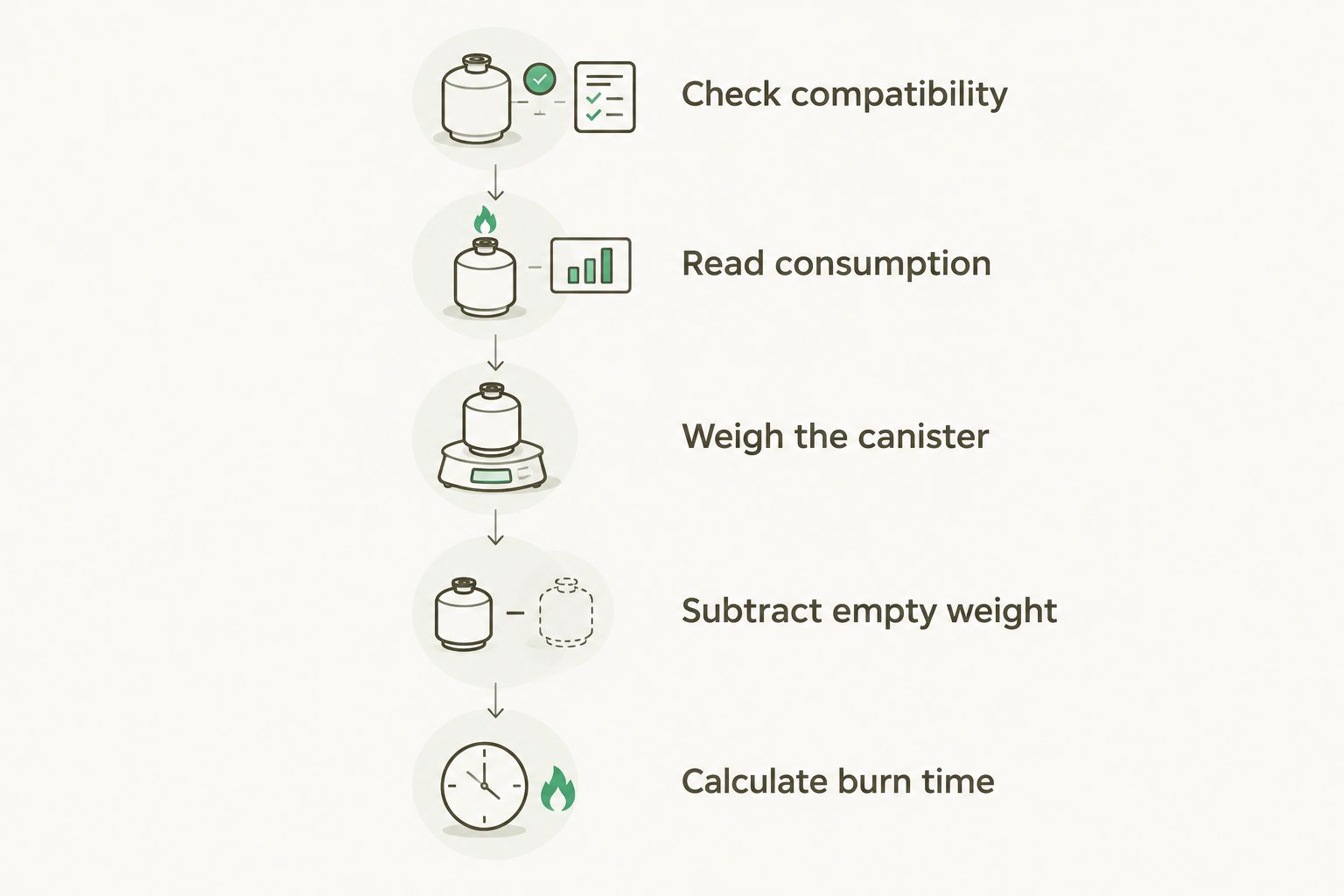
Use the stove instructions, the canister label and a kitchen scale. Do the checks at home, with the stove off and cool. Never disconnect a cartridge unless its design and the manufacturer’s instructions allow it.
- Check compatibility. Match the fuel type and connection to the stove manual. Similar-looking cartridges are not proof of compatibility.
- Read consumption. Find the manufacturer’s gas consumption figure and note the burner setting it describes.
- Weigh the canister. For a removable, self-sealing canister, weigh it separately from the stove, using the same cap arrangement each time.
- Subtract empty weight. Subtract the known empty weight of that exact canister type from its current total weight.
- Calculate burn time. Divide the remaining fuel weight by the consumption figure, then compare that estimate with your cooking plan.
An empty-weight figure must belong to the correct canister. Different containers carry different amounts of metal, even when their stated fuel contents look similar. Do not subtract a weight taken from an unrelated cartridge.
If the empty weight is unknown, weighing still helps you track consumption. Record the canister weight before and after cooking. The difference shows how much gas that session used, provided the canister was dry and weighed in the same condition.
Turn burn time into a realistic trip plan
For a 2026 trip, write down every planned hot meal and drink before choosing how much fuel to carry. Include arrival-night cooking, breakfast before departure and water heated for washing up. Those jobs are easy to leave out.
Your own cooking routine gives you a useful planning measure. Weigh a suitable removable canister before and after preparing a typical meal outdoors. Record the menu, water quantity, weather and whether you used a lid.
Repeat the check for the tasks you actually do. Boiling water for a drink and simmering a meal are different jobs. Do not use the result from one to promise the fuel requirement of the other.
| Cooking approach | Best for | Main advantage | Main limitation |
|---|---|---|---|
| Boil-only meals | Campers keeping preparation simple | Avoids prolonged cooking on the burner | Still needs enough water and fuel for every portion |
| One-pot meals | Campers reducing separate cooking tasks | Keeps preparation in a single pan | Long simmering still consumes fuel |
| Separate pans | Campers preparing different dishes | Gives more control over each dish | Adds burner use and handling |
| No-cook backup | Campers protecting against stove or fuel failure | Does not depend on a working stove | Does not replace the appeal of a hot meal |
Keep a fuel reserve rather than planning to finish with an empty canister. Base the reserve on the route, forecast, cooking needs and consequences of running short. There is no single reserve amount that fits every trip.
Why camping gas canister life varies
These factors change either the rate of gas use or the amount of burner time needed to finish cooking:
- Flame setting. A higher setting uses gas faster. Match the flame to the pan rather than letting flames spread around its sides.
- Wind exposure. Wind carries heat away from the pot and disrupts the flame. Follow the stove maker’s instructions for safe wind protection.
- Canister temperature and fuel blend. Cold affects vapour pressure and gas delivery. Use fuel approved for the stove and suited to the expected conditions.
- Water quantity and starting temperature. More water needs more energy to heat; colder water also needs more energy to reach the same final temperature.
- Pot and lid choice. A suitable lid reduces heat loss. Pot size and fit affect how effectively the burner heats the contents.
- Cooking method. Extended simmering, repeated reheating and separate batches add burner time, even when each individual task looks small.
At a campsite in Ireland, check the cooking position as well as the forecast. An exposed pitch and a sheltered outdoor cooking area do not give the same conditions. Shelter must never mean moving the stove into a tent or another enclosed space.
Make your gas last without compromising safety
Start with preparation. Have your food, water, pan and utensils ready before lighting the burner. Leaving the flame running while you search through a bag spends fuel without cooking anything.
Use a lid where the recipe allows it. Heat only the water you need, while allowing enough for safe food preparation. Once a pot reaches the required temperature, reduce the flame to the level needed to continue cooking.
Avoid judging efficiency by flame size. A flame spreading beyond the pan is not a useful target. Keep the stove stable, observe the manufacturer’s pan-size limits and turn it off when the cooking task is finished.
We recommend simple menus when camping fuel is limited. Boil-only meals suit campers reducing cooking time; one-pot meals suit campers reducing separate tasks. Neither removes the need to measure consumption and carry a reserve.
Do not improvise a windscreen
A windscreen that traps heat around a canister creates a serious hazard. Follow the exact instructions for your stove, especially when the burner sits directly on top of the cartridge.
Keep canisters away from flames, hot pans and other heat sources. Never warm a cartridge with a stove, fire or boiling water. Better fuel planning is the answer to poor cold-weather performance, not heating the container.
How can I tell how much gas is left?
Weighing a removable canister is the clearest way to measure remaining fuel when you know its empty weight. Use a scale displaying grams; a 1 g display increment lets you record small weight changes, although display resolution is not the same as guaranteed accuracy.
Write the empty weight on the canister only if that marking does not obscure the safety information. Alternatively, keep a note with your camping kit. Always identify the exact cartridge rather than assuming every empty container weighs the same.
Shaking tells you that liquid is moving inside, not how many meals remain. A weak flame is also not a fuel gauge: cold conditions, a connection problem or a stove fault need separate checks against the manual.
For your 2026 kit check, weigh partly used canisters before assigning them to a trip. Do not pack an unknown remainder as your only fuel for essential cooking.
Does turning the flame down make a canister last longer?
A lower flame reduces gas flow, but useful fuel savings depend on completing the cooking task efficiently. A very low flame that struggles against wind is not automatically the best setting.
Use enough heat to bring the pot to the required temperature, then reduce it when the task allows. Keep the pan covered where appropriate, and do not compromise safe cooking temperatures to save fuel.
Will one canister last a weekend in Ireland?
One canister lasts a weekend only when its usable fuel covers your planned cooking and a reserve. The number of campers, meals, hot drinks and weather conditions determines the requirement, not the word weekend.
For a 2026 weekend plan, count cooking sessions and use your measured consumption as the starting point. If the remaining fuel is uncertain, do not make it your sole supply for meals that require cooking.
FAQ
How long does a camping gas canister last on full power?
Full-power burn time is the usable fuel weight divided by the stove manufacturer’s full-power consumption in grams per hour. The result is a calculation, not a guarantee of useful cooking time in wind or cold.
Can I work out camping gas burn time in minutes?
Multiply the calculated burn time in hours by 60 minutes per hour. First check that both fuel weight and hourly consumption use grams.
Does a bigger camping gas canister always last longer?
More usable fuel gives longer calculated burn time at the same consumption rate. Check fuel compatibility and remaining contents rather than judging by the container’s physical size.
Can I use a camping stove inside a tent if it is raining?
No. Use a camping stove outdoors, away from tents and enclosed spaces, because of fire and carbon monoxide risks. Rain does not make indoor use safe.
Why does my camping stove struggle when the canister still has gas?
Gas remaining in the canister does not guarantee normal gas delivery. Cold conditions affect vapour pressure; connection or stove problems also require checks against the manufacturer’s instructions.
Can I disconnect a partly used camping gas canister?
Disconnect a partly used canister only when its design and the stove instructions permit it. Do not remove a pierceable cartridge before it is empty unless the manufacturer explicitly provides for safe removal.
Can I put an empty camping gas canister in household recycling in Ireland?
Follow your local waste facility’s instructions for camping gas canisters. Do not assume an apparently empty cartridge is accepted in household recycling, and never puncture or burn it yourself.
One last thing
A nearly empty canister and a cold canister can both produce a disappointing flame, but they need different decisions. Check the remaining fuel by weight where possible, then follow the stove’s troubleshooting instructions. Do not assume the answer is to open the valve further or heat the canister.
Before your next trip, record the weight of a suitable removable canister before and after making your usual camp meal. That simple habit gives you a fuel-use record tied to your stove, your pan and your cooking—not somebody else’s weekend.