

How long does a trail camera battery last?
A trail camera battery has no fixed lifespan: the camera, battery type, recording settings and activity at the site determine how long it lasts. Standby life is not recording life, so a headline endurance claim does not tell you how long your camera will keep capturing wildlife in Ireland. For a dependable 2026 setup, use the batteries specified in the manual and base your replacement schedule on results from your own location.
- How long does a trail camera battery last? Recording activity, infrared use and battery compatibility determine the answer.
- For wildlife monitoring in Ireland, we recommend checking actual captures rather than relying on standby claims.
- Hikmicro M15 4G buyers should confirm battery requirements before choosing cells or an external supply.
- Reduce unwanted triggers before cutting settings that capture the wildlife you want to see.
How long does a trail camera battery last?
There is no single battery-life figure that applies to every trail camera. Compare endurance claims only when they describe the same battery chemistry, recording mode, trigger activity and operating conditions.
A camera waiting for movement has a different workload from one recording repeated night-time video. Sending images adds another task on models with remote transmission. Our trail camera-to-phone setup workflow covers that separate part of the setup.
| Camera workload | What the batteries power | Best for | Main limitation |
|---|---|---|---|
| Motion-triggered stills | Detection, image capture and storage | Identifying visitors to a quiet location | Stills do not show a complete movement sequence |
| Video recording | Detection, sustained recording and storage | Studying behaviour | Longer recordings increase the workload |
| Night recording | Capture plus infrared illumination | Monitoring after dark | Illumination adds to power demand |
| Remote image delivery | Capture plus communication | Sites you cannot visit regularly | Upload activity adds another battery load |
These workloads overlap. A camera recording night video and transmitting files is not operating under the same conditions as a daytime stills camera.
Why this matters
A flat battery leaves a gap in your recordings. That gap is easy to mistake for a quiet site, particularly when you only collect the memory card occasionally.
For your 2026 monitoring plan, separate two questions: how long the camera remains powered, and how long it records useful evidence. Useful captures matter more than a battery indicator that stays high. A setting that saves power by missing your subject is not an improvement.
In Ireland, review the installation when daylight, vegetation and weather change. A setup facing bare branches does not face the same scene once leaves grow across its detection area.
Why trail camera battery life varies
Battery endurance depends on the complete installation, not just the name printed on the cells. Start with these factors before changing equipment.
- Trigger frequency: each recording event adds work. Repeated unwanted triggers spend power without adding useful footage.
- Recording length: keeping the camera recording for longer increases its active workload.
- Infrared use: night-time illumination requires power alongside the camera itself.
- Transmission activity: sending images uses energy in addition to capturing and storing them.
- Battery chemistry and condition: the camera needs a compatible supply that can support its operating load.
- Temperature: battery performance changes with temperature, so a result from mild conditions is not a winter guarantee.
Change settings to match the job. A wildlife behaviour project needs different evidence from a camera used simply to establish whether an animal visits a gate.
Which batteries should you use in a trail camera?
Use the battery chemistry and size approved for your exact camera. A cell fitting inside the compartment does not establish electrical compatibility.
The voltage printed on a battery matters. So does whether the camera manufacturer accepts that battery type. Do not treat every product described as lithium as interchangeable.
| Battery type | Typical nominal cell voltage | Best for | Main limitation |
|---|---|---|---|
| Alkaline AA | 1.5 V | Cameras whose manuals specify alkaline cells | Performance under load and in cold conditions differs from other chemistries |
| Primary lithium AA | 1.5 V | Compatible cameras used in cold conditions | Not rechargeable; approval still needs checking |
| NiMH rechargeable AA | 1.2 V | Cameras explicitly supporting rechargeable NiMH cells | Lower nominal voltage than alkaline AA cells |
| Lithium-ion cell | Often 3.6 V or 3.7 V | Equipment designed for that exact cell type | Not a substitute for an ordinary AA battery |
A rechargeable AA marked 1.2 V is not electrically identical to a 1.5 V alkaline AA. Equally, a 3.6 V lithium-ion cell must not replace a lower-voltage cell simply because it appears to fit.
For your 2026 battery purchase, read the camera manual before comparing capacity labels. Capacity alone does not establish suitability, and a larger printed figure does not prove longer service in your installation.
Replace the battery set together. Follow the manufacturer's instructions on cell type, polarity and charging, and never attempt to recharge a primary battery.
How do you establish battery life at your own site?
Build a record you can repeat. You do not need to run the camera completely flat to learn whether the installation is demanding too much power.
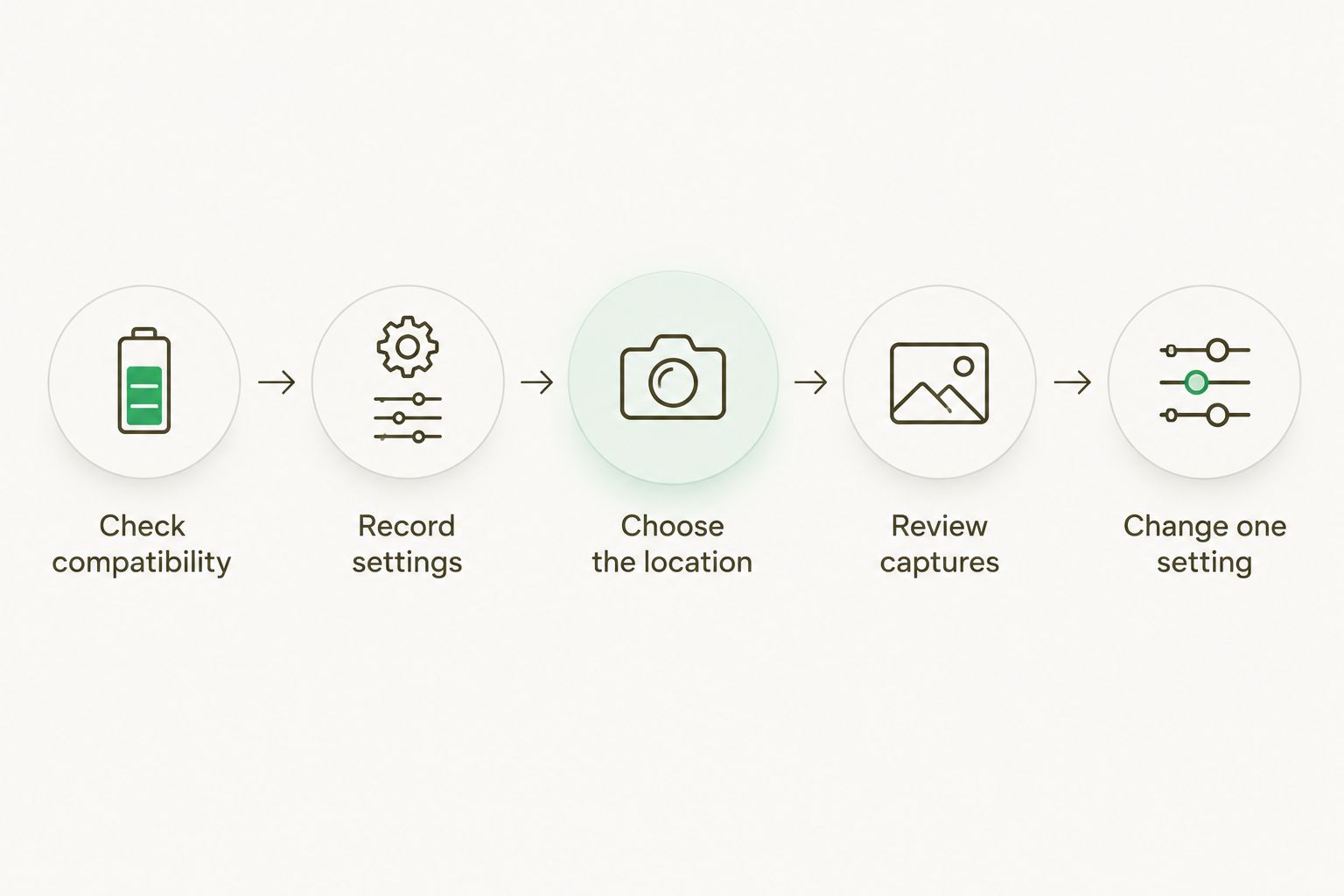
- Check compatibility. Confirm the approved batteries, memory card and any external power requirements in the camera manual.
- Record settings. Note the recording mode, clip length, trigger interval, infrared settings and transmission options available on your model.
- Choose the location. Aim at the intended route and remove nearby moving vegetation from the detection area where practical.
- Review captures. Check battery status alongside successful recordings, unwanted triggers and night-time results.
- Change one setting. Adjust a single cause of unnecessary activity, then compare the next review with your notes.
Keep the start date, battery type and camera settings together. Otherwise, a change in endurance tells you little about what caused it.
What should you write in the camera log?
Record what explains the workload, not just the battery symbol. Include whether the files are mainly daytime photographs, night photographs or video, and whether the camera sends them remotely.
Also note blank captures, moving branches and any obvious change in the scene. If a camera suddenly records vegetation throughout the night, the extra activity gives you a reason to inspect its aim before blaming the batteries.
Keep separate notes for separate locations. A quiet woodland route and a busy farm entrance are different workloads, even when you use identical cameras.
How can you make trail camera batteries last longer?
Remove wasted activity before reducing useful coverage. Start by looking through the files rather than immediately turning down every setting.
Correct the camera position
A flexible mounting point lets the view move. Nearby foliage also changes what the camera sees as wind passes through it. Secure the camera firmly and inspect the foreground as well as the animal route.
Do not clear habitat unnecessarily. Repositioning the camera or changing its angle is often the more practical response to an obstructed view.
Match recordings to the question
Use stills when identification is enough. Choose video when behaviour is the reason for installing the camera, then select a clip length that captures that behaviour without continuing long after the subject leaves.
A longer trigger interval reduces repeat captures, but it also leaves more time between recording opportunities. Keep that trade-off visible. Do not extend the interval blindly on a route where animals pass quickly.
Review remote delivery settings
Where the model offers upload schedules or limits, match them to how quickly you need the images. Immediate notification and occasional collection serve different purposes.
Before buying a connected model such as the Hikmicro M15 4G trail camera, confirm its battery requirements and available recording and delivery settings. Connectivity is relevant when you need remote images; it is not, by itself, evidence of longer battery life.
Does infrared night recording drain batteries faster?
Infrared illumination adds an electrical load while the camera records after dark. A night-heavy installation therefore needs a different battery plan from a camera mainly taking daylight photographs.
The proportion of night captures matters as much as the camera's location. Review the files before changing illumination settings, because reducing illumination at the expense of identification defeats the purpose of the recording.
The electrical checks involved in choosing batteries for IR illuminators also matter here: match the specified voltage and chemistry rather than choosing cells on size alone. A separate illuminator's battery recommendation does not establish compatibility with your trail camera.
For autumn and winter monitoring in Ireland in 2026, inspect actual night recordings when you review power use. Look for successful captures and usable detail, not merely confirmation that the camera switched on.
Can you use an external battery or solar panel?
Use external power only when the camera supports it and the supply meets its requirements. Check voltage, polarity, connector specification and the manufacturer's instructions for operating with internal batteries fitted.
An external battery adds stored energy, but it also adds connections and equipment to protect. Do not connect a general-purpose battery directly to a camera without confirming the complete electrical match. A matching plug is not enough.
Solar charging introduces another dependency: the panel needs suitable light, and the charging arrangement must support the battery chemistry. Shade and changing daylight affect the energy available for charging.
Treat external power as a compatible system, not an automatic cure. Fix repeated false triggers first; otherwise, you are supplying more energy to the same avoidable workload.
Why does a trail camera stop while the battery indicator shows charge?
A battery indicator is an estimate, not proof that the supply can support every recording task. A camera can encounter a power problem during illumination or transmission even though its display previously showed remaining charge.
Check the approved battery type, contacts and polarity first. Then inspect recordings to establish whether the failure coincides with night operation or remote delivery. That distinction helps you describe the fault clearly.
Do not assume every recording failure is a battery failure. Storage, setup and communication problems also need checking against the manual, especially when the camera still powers on normally.
How often should you check a trail camera in Ireland?
Set the inspection schedule from the camera's observed workload and the importance of uninterrupted coverage. A newly installed camera needs a review before you trust it for a long unattended deployment.
Repeat that review after changing batteries, settings or location. In your 2026 log, keep results from different seasons separate rather than treating a mild-weather result as an all-weather promise.
For a site you cannot easily revisit, prioritise an approved power arrangement and a clear maintenance plan. Remote access helps you inspect delivered images, but it does not replace checking the physical installation when a problem appears.
FAQ
How long does a trail camera battery last in Ireland?
Trail camera battery life depends on the model, approved batteries, recording workload and conditions at the site. Use actual recordings and battery checks to establish a replacement schedule rather than treating standby endurance as recording endurance.
Do trail camera batteries last longer when taking photos instead of video?
Still photographs generally require less recording time than video, but trigger frequency and night illumination also affect the workload. Use stills when identification is enough and video when you need to record behaviour.
Can I put rechargeable AA batteries in my trail camera?
Use rechargeable AA batteries only if the camera manufacturer approves them. NiMH AA cells have a nominal voltage of 1.2 V, compared with 1.5 V for alkaline AA cells, so they are not automatically interchangeable.
Are lithium batteries and lithium-ion batteries the same for trail cameras?
Primary lithium AA batteries and rechargeable lithium-ion cells are not interchangeable battery types. Check the exact chemistry, voltage, size and charging instructions specified for the camera.
Why does my trail camera use batteries so quickly at night?
Night recording requires power for infrared illumination as well as capture and storage. Review repeated triggers and recording length before reducing settings needed for clear identification.
Will a solar panel keep my trail camera running without battery changes?
A solar panel does not guarantee uninterrupted operation. The camera, battery and charging system must be compatible, and the panel needs enough light to support the installation's energy demand.
Should I replace all the batteries in a trail camera together?
Replace the battery set together and follow the camera manufacturer's instructions. Do not mix battery chemistries or attempt to recharge cells marked as non-rechargeable.
One last thing
Check the last successful night recording, not just the last daylight photograph. Daylight operation alone does not demonstrate that the batteries can support infrared recording as well.
Before leaving a camera unattended, verify the functions you actually need: detection, recording, night illumination and remote delivery where fitted. A working power light is only the beginning of that check.