

Portable Generator for Camping: Inverter Wins | 2026
Best fuel-powered option: a petrol inverter generator. Best for quiet, light-duty camping: a battery power station. Best for a fitted campervan: a properly installed leisure-battery system. For your 2026 trips in Ireland, we recommend choosing the power system around your appliances, campsite rules and charging opportunities—not the biggest output figure.
- Choose a petrol inverter portable generator for camping when you need fuel-powered electricity and the campsite permits it.
- A battery power station suits quiet camping and campervan charging, but its stored energy is finite.
- A leisure-battery system suits fitted campervans; a standalone battery is not a complete mains power supply.
- Never run a fuel-powered generator inside a tent, campervan, awning or enclosed shelter.
Why this matters
A generator produces electricity from fuel. A portable power station stores electricity in a battery. Both can power camping equipment, but they solve different problems.
For phones, lighting and occasional laptop charging, start with our guide to portable power stations for camping and campervans in Ireland. You avoid exhaust and engine noise, although battery capacity and recharging still limit your trip.
For repeated electricity use away from charging points, a fuel-powered generator belongs on the shortlist. It also brings fuel storage, servicing and a strict outdoor operating requirement. Before buying anything for an Irish campsite, ask whether generators are permitted and what operating hours apply.
What makes the best portable generator for camping?
We use these criteria for the 2026 shortlist. They apply whether you camp beside the car or travel in a campervan.
- Continuous output: Match the rated running output to the appliances you will use together. Peak output is not the continuous rating.
- Starting demand: Check appliances with motors or compressors separately. Their starting demand can exceed their running demand.
- Energy and runtime: Compare battery capacity or fuel runtime at a stated load. An unexplained runtime figure tells you little.
- Noise and permissions: Read noise measurements with their test distance and load. Confirm campsite permission before choosing an engine-powered option.
- Connections and protection: Check sockets, output quality, weather instructions and the required electrical protection. Irish mains equipment normally uses 230 V at 50 Hz.
- Carry and recharge: Check the complete carrying weight and how you will replenish energy. Include fuel, cables, chargers and any separate inverter.
Choose the smallest system that meets your actual load and trip duration. Extra output does not fix poor charging access, unsuitable sockets or a campsite ban.
Camping power options at a glance
This comparison ranks power-system types by use case. A battery power station and a leisure battery are alternatives to a generator, not fuel-powered generators themselves.
| Rank and option | Best for | Standout feature | Key limitation |
|---|---|---|---|
| 1. Petrol inverter generator | Repeated off-grid mains use where generators are permitted | Produces electricity while fuel is available | Exhaust, engine noise and outdoor-only operation |
| 2. Battery power station | Quiet tent camping and portable charging | Battery storage with integrated outputs | Finite energy and a need to recharge |
| 3. Leisure-battery system | A campervan with permanently fitted electrical equipment | Integrated power for the vehicle's living area | Requires suitable installation and charging equipment |
| 4. Conventional portable generator | Separate outdoor utility work rather than shared campsites | Fuel-powered output without an inverter-generator design | Output quality and noise need particular scrutiny |
1. Petrol inverter generator: best for repeated off-grid mains use
A petrol inverter generator uses an engine and electronic conversion to supply electricity. Choose a model whose documented output suits your appliances; the word inverter alone does not prove compatibility with every charger or device.
This is the strongest generator category to investigate when your trip requires repeated mains electricity without a dependable charging point. It only makes sense where you have permission and a safe outdoor operating position.
Petrol inverter generator pros:
- Produces electricity without waiting for a mains charging point.
- Supports extended use through refuelling, subject to its operating instructions.
- Offers a portable alternative to a permanently installed generating system.
Petrol inverter generator cons:
- Produces exhaust containing carbon monoxide.
- Adds engine noise, maintenance and fuel-handling requirements.
- Cannot operate inside your tent, campervan or awning.
Best for: Campers who need repeated mains power at an approved location and can manage the generator safely.
Before choosing a model, check its continuous rating, starting capability, socket configuration and output-quality specification. Read runtime figures at the stated load. Do not assume a light-load runtime applies when several appliances run together.
Verdict: Buy a petrol inverter generator only when your load, campsite permission and outdoor setup justify it.
2. Battery power station: best for quiet tent camping
A battery power station stores energy and supplies it through its fitted outputs. Depending on the model, these include USB, DC and mains sockets; check the actual specification rather than assuming all connections are present.
A battery power station does not produce engine exhaust during use. It suits charging and lighting near your camping setup, provided you follow its temperature, ventilation and moisture instructions.
Battery power station pros:
- Avoids the exhaust of a fuel-powered generator.
- Needs no petrol handling during operation.
- Keeps battery storage and outputs in a portable unit.
Battery power station cons:
- Stops supplying power when its usable stored energy runs out.
- Has separate limits for stored energy and maximum output.
- Needs a realistic recharging plan for longer trips.
Best for: Quiet camping, phones, lights and compatible portable appliances with a manageable energy demand.
For a 2026 weekend away in Ireland, list your charging needs before choosing capacity. Check mains charging, vehicle charging and solar compatibility separately. A solar input does not mean a panel is included, and a vehicle connection does not guarantee rapid charging.
Fans and other cooling components can still make noise. Battery-powered does not automatically mean completely silent.
Verdict: Buy a battery power station when quiet operation matters and your energy budget fits its usable capacity.
3. Leisure-battery system: best for a fitted campervan
A leisure-battery system supplies the campervan's living-area equipment through installed wiring and protection. Mains appliances require a suitable inverter or an appropriate external mains connection; a battery by itself does not provide a household socket.
A Powerpack LiFePO4 lithium battery with Bluetooth, 12 V 100 Ah is a battery component, not a complete portable generator. Its named capacity does not establish compatibility with your campervan's charger, wiring or appliances.
Leisure-battery system pros:
- Integrates with the campervan's fitted living-area equipment.
- Supplies compatible DC equipment without running a generator.
- Can form part of a system with suitable vehicle, mains or solar charging.
Leisure-battery system cons:
- Requires compatible charging equipment, wiring and protection.
- Needs a separate inverter for mains output when away from hookup.
- Is less convenient to move between a vehicle and a tent.
Best for: Campervan owners building or upgrading a properly designed electrical system.
Do not choose a battery chemistry in isolation. Confirm the charger profile, battery-management requirements, installation instructions and any restrictions on charging temperatures. Have a competent installer assess the complete system.
Verdict: Buy a leisure-battery system for an integrated campervan setup; skip a standalone battery as a ready-to-use generator substitute.
4. Conventional portable generator: best for separate utility use
A conventional portable generator produces electricity from an engine without the same conversion arrangement as an inverter generator. Its suitability depends on the particular model's output regulation, sockets and operating instructions.
Do not select this category for camping simply because the headline output looks attractive. Check the connected equipment's requirements and whether the generator belongs at the site at all.
Conventional portable generator pros:
- Produces electricity independently of a battery charging point.
- Supports repeated operation through fuel replenishment.
- Can serve suitable outdoor utility loads when correctly specified.
Conventional portable generator cons:
- Produces exhaust and requires safe outdoor placement.
- Output quality needs checking against sensitive equipment.
- Engine noise makes it a poor default for shared camping spaces.
Best for: Separate outdoor utility tasks with compatible loads, not quiet camping beside other pitches.
Verdict: Skip a conventional generator as your default camping purchase.
Check your load before choosing a system
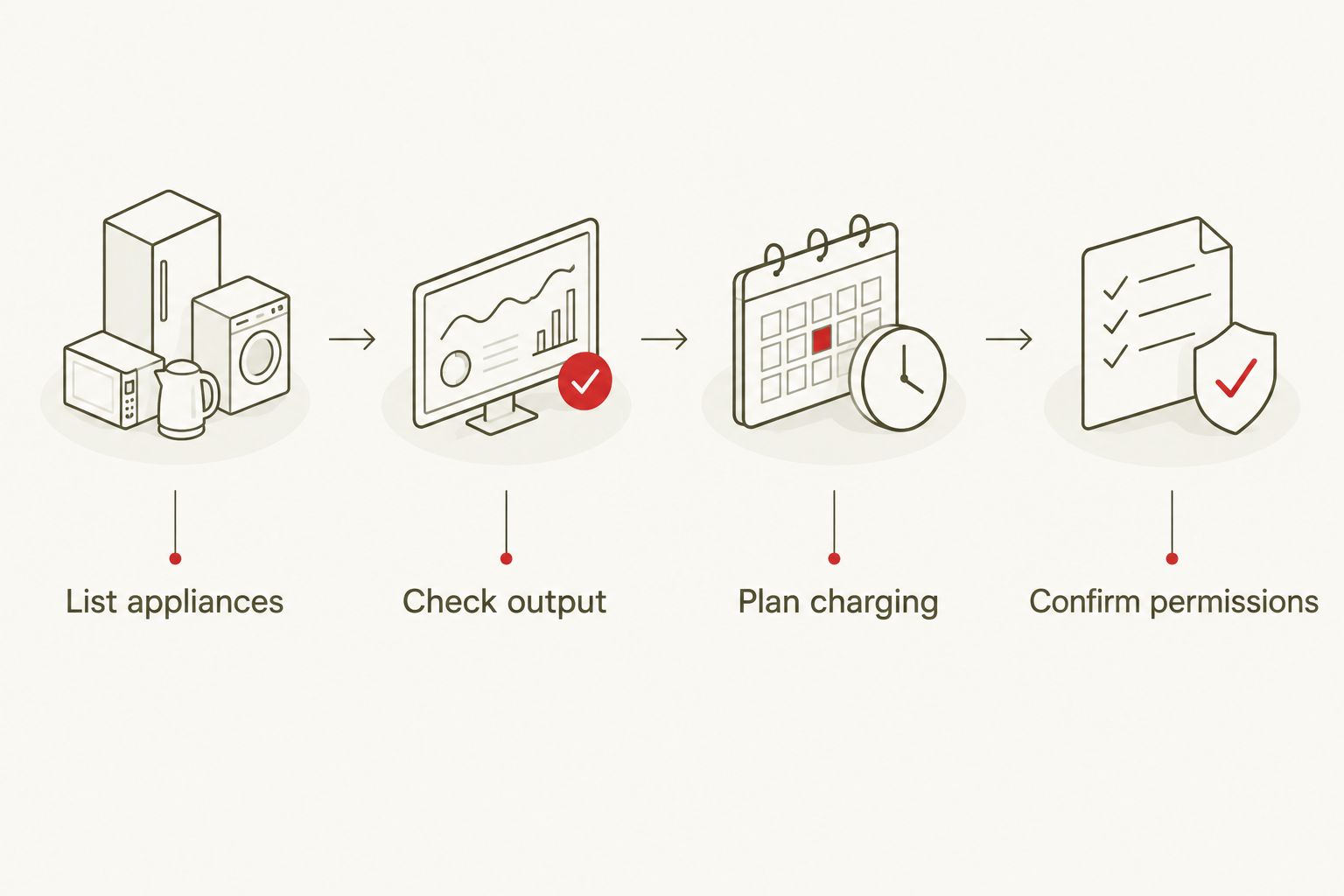
Your 2026 buying checklist starts with the appliance labels. Write down running power, any documented starting demand and how long each appliance will operate. Separate essential equipment from things you can leave at home.
- List appliances: Include chargers, lighting, refrigeration and any other electrical equipment.
- Check output: Add the loads that will run together. Check starting demand separately.
- Plan charging: Identify where batteries can recharge or where permitted generator operation is possible.
- Confirm permissions: Ask the campsite about generators, hookups and operating restrictions.
Watts describe power at a moment. Watt-hours describe stored or consumed energy over time. A power station can have enough energy for your trip but insufficient output for a particular appliance—or enough output but insufficient energy for the duration.
Avoid converting a battery's amp-hour figure into promised appliance runtime. Voltage, usable capacity, discharge limits and conversion losses all matter. Use the complete system specification, not one number on the battery label.
Generator safety for camping in Ireland
Never run a fuel-powered generator inside a tent, campervan, awning, garage or other enclosed space. Opening a door or window does not make indoor operation safe. Carbon monoxide is colourless and odourless.
US Centers for Disease Control and Prevention guidance places portable generators at least 20 feet—about 6 metres—from doors, windows and vents. Apply that separation to neighbouring tents and vehicles as well as your own, and follow any stricter manufacturer instructions. Keep exhaust directed away from occupied spaces.
- Stop the engine and let it cool before refuelling.
- Keep the generator and electrical connections dry without enclosing the engine or blocking ventilation.
- Follow the manufacturer's fuel-storage and transport instructions.
- Use suitable outdoor cables and electrical protection.
- Never backfeed a campervan or building through an improvised socket connection.
Rain does not justify moving a running generator beneath a tent porch or into an awning. Follow the manufacturer's approved wet-weather arrangements. If you cannot provide a safe operating position, do not run it.
For a campervan hookup connection, have a competent electrician confirm the supply arrangement and protection. An adapter alone does not establish a safe connection.
How we ranked the options
For this 2026 guide, we prioritise appliance suitability, campsite permission, safe operation and energy replenishment. Portability and noise follow. No category wins every use case.
A petrol inverter generator leads for permitted, repeated fuel-powered electricity. A battery power station leads for quiet portable use. A leisure-battery system leads for integrated campervan equipment. Conventional generators sit last because they are not the default answer for shared camping spaces.
Which camping power system should you choose?
For phones, lighting and modest portable charging, start with a battery power station. Check its outputs and usable capacity against your equipment. Plan how you will recharge before extending the trip.
Choose a petrol inverter generator when the battery approach does not meet your needs and the location permits safe generator use. Choose an installed leisure-battery system when the equipment belongs permanently in your campervan.
We recommend removing unnecessary electrical loads before buying more generating capacity. Outdoor cooking equipment can take meal preparation off the electrical system, but fuel-burning cookers also require a safe location and strict compliance with their instructions.
FAQ
What's the best portable generator for camping in Ireland?
A petrol inverter generator is the best fuel-powered category to investigate for camping where generator use is permitted. Match its continuous output, starting capability and connections to your appliances. For light charging and quiet camping, consider a battery power station instead.
Is a portable power station the same as a generator?
No. A portable power station stores electricity in a battery, while a fuel-powered generator produces electricity from an engine. A power station needs recharging; a generator needs fuel and safe outdoor operation.
Can I run a generator inside a campervan or awning?
No. Never run a fuel-powered generator inside a campervan, tent or awning because its exhaust contains carbon monoxide. Open windows and doors do not make indoor operation safe.
What size generator do I need for camping?
Choose generator output from the appliances you will run together and their documented starting demands. Use the continuous rating rather than treating the peak rating as sustained output. There is no single correct size for every camping setup.
Can I use a portable generator at an Irish campsite?
You need the campsite's permission before using a portable generator. Ask about operating hours and placement requirements before booking or travelling. A generator's portability does not establish permission to use it.
Will a jump starter power my campervan appliances?
A jump starter is not automatically a campervan appliance power supply. Check its documented outputs, stored energy and operating limits. A peak jump-start current rating does not establish sustained mains output.
Can a generator charge a campervan leisure battery?
A generator can supply a compatible battery charger when the generator, charger and electrical connection are suitable. Do not connect mains output directly to a battery. Confirm charging compatibility and the installation's protection requirements.
One last thing
Before your first 2026 trip, run the complete power setup at home according to its instructions. Use the actual appliances and cables you will pack. For a fuel-powered generator, that test must take place outdoors with safe separation from doors, windows and vents.
A successful phone charge proves only that one charger works. It does not prove your fridge will start, your battery will last the trip or your campervan connection is safe.