

Waterproof Map Case: Best Double-Sided Design 2026
Best overall: a double-sided waterproof map case with a positive-lock closure. Best for keeping spare maps dry: a roll-top document pouch. Best for occasional use: a compact resealable map pouch. This 2026 guide compares case designs for hillwalking in Ireland, with the checks that matter before you buy.
- Choose a double-sided waterproof map case for regular hillwalking in Ireland; read both sides without opening the seal.
- Choose a roll-top document pouch for spare maps, not frequent route checks.
- Match the usable window to your folded paper map, not the case’s outside dimensions.
- Check closure instructions, map readability and attachment points before choosing a hillwalking map holder.
Why this matters
A map case has two jobs: protect your paper and let you read it. A pouch that keeps the map dry but hides the next junction behind a fold solves only half the problem.
For Irish hillwalking, choose around the map you carry and the way you check your route. Keep spare sheets separately; our guide to dry bags for hillwalking and bushcraft trips in Ireland explains that part of your packing setup.
We recommend a double-sided waterproof map case for hillwalkers who need frequent access to a paper map. The ranking below compares designs, not named models or laboratory-tested products. Use it to identify the right format, then check the individual manufacturer’s specifications.
What makes the best waterproof map case?
Judge a map holder on these points before looking at extras:
- Closure: Look for clear sealing instructions and a closure you can inspect along its full length. An ordinary zip is not evidence of waterproof protection.
- Usable window: Measure the clear area inside the seams and closure. The external dimensions do not tell you how much map you can see.
- Readability: Check small contour labels and grid numbers through the panel. Creases, reflections and scratched plastic interfere with reading.
- Handling: Try inserting your folded map and operating the closure with the gloves you use outdoors. Do this before taking the case onto a hill.
- Attachment: Choose a secure attachment point and keep the case close to your body or pack. Avoid leaving a long cord dangling.
- Declared protection: Read the manufacturer’s water-protection statement. Do not treat rain protection and immersion protection as interchangeable.
For a 2026 purchase, the deciding question is simple: can you read the next part of your route without opening the case? That matters more than pockets you will not use.
Waterproof map case designs at a glance
| Rank and design | Best for | Standout feature to seek | Key limitation |
|---|---|---|---|
| 1. Double-sided positive-lock case | Frequent route checks | Clear panels on both sides and an inspectable closure | Your route still needs to fit the visible area |
| 2. Roll-top document pouch | Spare maps and route notes | A closure used exactly as instructed | Opaque versions require opening to read the contents |
| 3. Compact resealable map pouch | Short routes on a folded sheet | A small clear window with a fully resealable opening | Limited room for surrounding terrain |
| 4. Large-format clear map case | Group briefings and broad route views | A larger clear area for spreading out the map | More awkward to handle in wind |
These options have distinct jobs. The first is the default for reading on the hill; the second is primarily storage. The smaller and larger formats trade viewing area against handling.
1. Double-sided case: best for frequent route checks
A double-sided map case lets you read through either face of the pouch. Fold the map so useful sections face outwards, then turn the closed case over when you need the reverse side.
Choose a version with a positive-lock closure and explicit waterproof instructions. A clear panel alone says nothing about the seal.
Double-sided case pros:
- Read both exposed map faces without opening the pouch.
- Put your outward and return sections on opposite sides.
- Check the position of the folded map through the panels.
- Keep the working map separate from spare paperwork.
Double-sided case cons:
- Terrain hidden inside the fold remains hidden.
- Reflections and surface wear affect both viewing panels.
- Refolding the map still requires opening the closure.
Best for: Regular hillwalkers who stop often to confirm junctions, contours and route direction.
Before choosing, insert your actual map rather than an empty sheet. Check that the closure shuts without catching paper and that important grid numbers remain visible. Turn the case over and repeat the check.
Verdict: Buy this design as your default, provided the declared protection and usable window suit your map.
2. Roll-top document pouch: best for spare maps
A roll-top document pouch stores folded maps and route notes behind a rolled closure. Follow the manufacturer’s instructions for closing it; do not assume every pouch needs the same number of folds.
Choose this format for paperwork you want protected inside your pack. If you intend to read through it, check that the pouch has a clear viewing panel rather than an opaque body.
Roll-top document pouch pros:
- Keeps spare sheets together.
- Separates backup paperwork from the map you are using.
- Provides a dedicated place for printed route notes.
Roll-top document pouch cons:
- An opaque pouch must be opened before you can read the map.
- The rolled opening takes up part of the pouch’s usable space.
- Access involves undoing and correctly remaking the closure.
Best for: Walkers carrying spare map sheets or printed notes for a longer trip.
Pack the spare map dry. A waterproof pouch does not dry damp paper, and putting wet notes beside your backup map defeats the point of separating them.
Verdict: Buy for backup storage; skip opaque versions as your main reading case.
3. Compact resealable pouch: best for short mapped routes
A compact resealable map pouch holds a smaller folded section behind a clear panel. Choose a purpose-made waterproof version with sealing instructions, not a stationery wallet with a similar appearance.
This format suits a route that fits comfortably in the window. Leave nearby paths and terrain visible rather than folding down to a narrow strip around your planned line.
Compact resealable pouch pros:
- Holds a small working section of the map.
- Packs into a smaller space than a large-format case.
- Keeps the setup simple when you need only one exposed section.
Compact resealable pouch cons:
- Shows less surrounding terrain.
- Requires opening if the route runs beyond the visible section.
- A closure partly obstructed by paper will not seat correctly.
Best for: Occasional walkers using a short route on a compact folded sheet.
Check the seal from end to end each time you close it. Keep grit and loose paper edges away from the sealing channel, and follow the cleaning instructions for that model.
Verdict: Buy when your route and nearby alternatives fit the window; skip when frequent refolding is unavoidable.
4. Large-format clear case: best for group route planning
A large-format clear map case exposes more of a sheet at once. It suits discussions about the wider route, neighbouring valleys and alternative ways back.
Choose it for the viewing area, not simply because a larger case looks more protective. Protection still depends on the material, seams and closure specified for the individual model.
Large-format case pros:
- Shows more terrain without refolding.
- Makes a map easier to share during a stopped group briefing.
- Gives more room to compare the planned route with alternatives.
Large-format case cons:
- Takes more space when left unfolded.
- Presents a larger surface to the wind.
- Becomes less useful if you fold it down and hide the extra viewing area.
Best for: Group leaders and walkers who regularly need a broad view of the map.
Check where the case will sit when you are not reading it. If it obstructs your hands, catches your poles or swings across your body, change the carrying arrangement before setting out.
Verdict: Buy for broad map views; skip as your everyday choice if compact handling matters more.
Choose the viewing area before the outer size
Paper sizes give you a useful starting point. A4 measures 210 × 297 mm, A5 measures 148 × 210 mm, and A3 measures 297 × 420 mm. Those are paper dimensions, not guaranteed map-case capacities.
A case advertised with an A4-sized exterior does not necessarily accept an unfolded A4 sheet. Seams, the closure and any reinforced border take up room. Check the stated internal dimensions and clear viewing area separately.
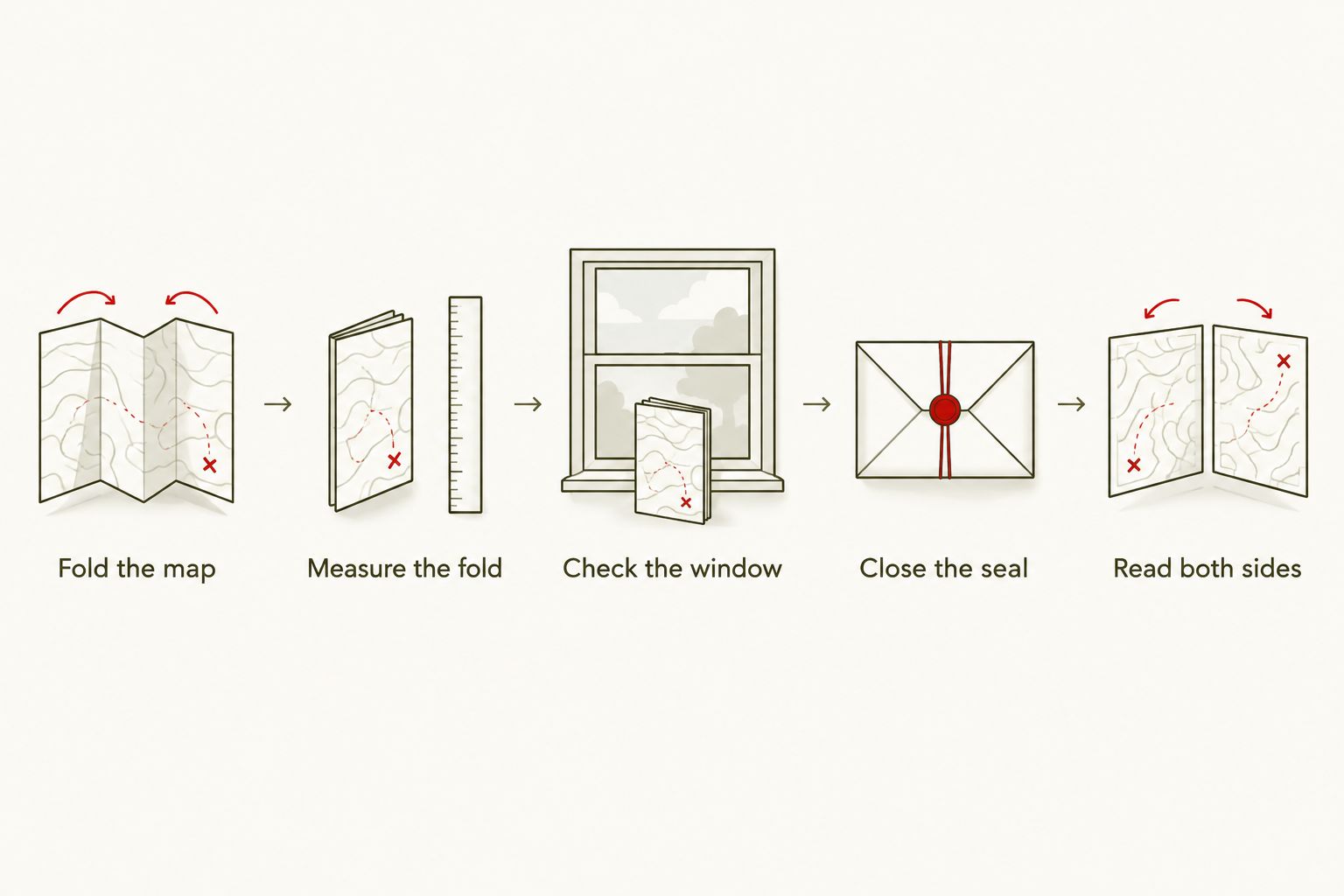
A simple fit check
- Fold the map: Expose your route, nearby terrain and useful grid labels.
- Measure the fold: Measure the paper as you intend to carry it.
- Check the window: Compare that measurement with the clear usable area.
- Close the seal: Keep every paper edge below the sealing line.
- Read both sides: Check the outward section and your return options.
The right size is the one that shows enough information without becoming awkward to handle. For your 2026 kit, start with the map fold and work outwards—not with the biggest pouch.
Check readability with a compass
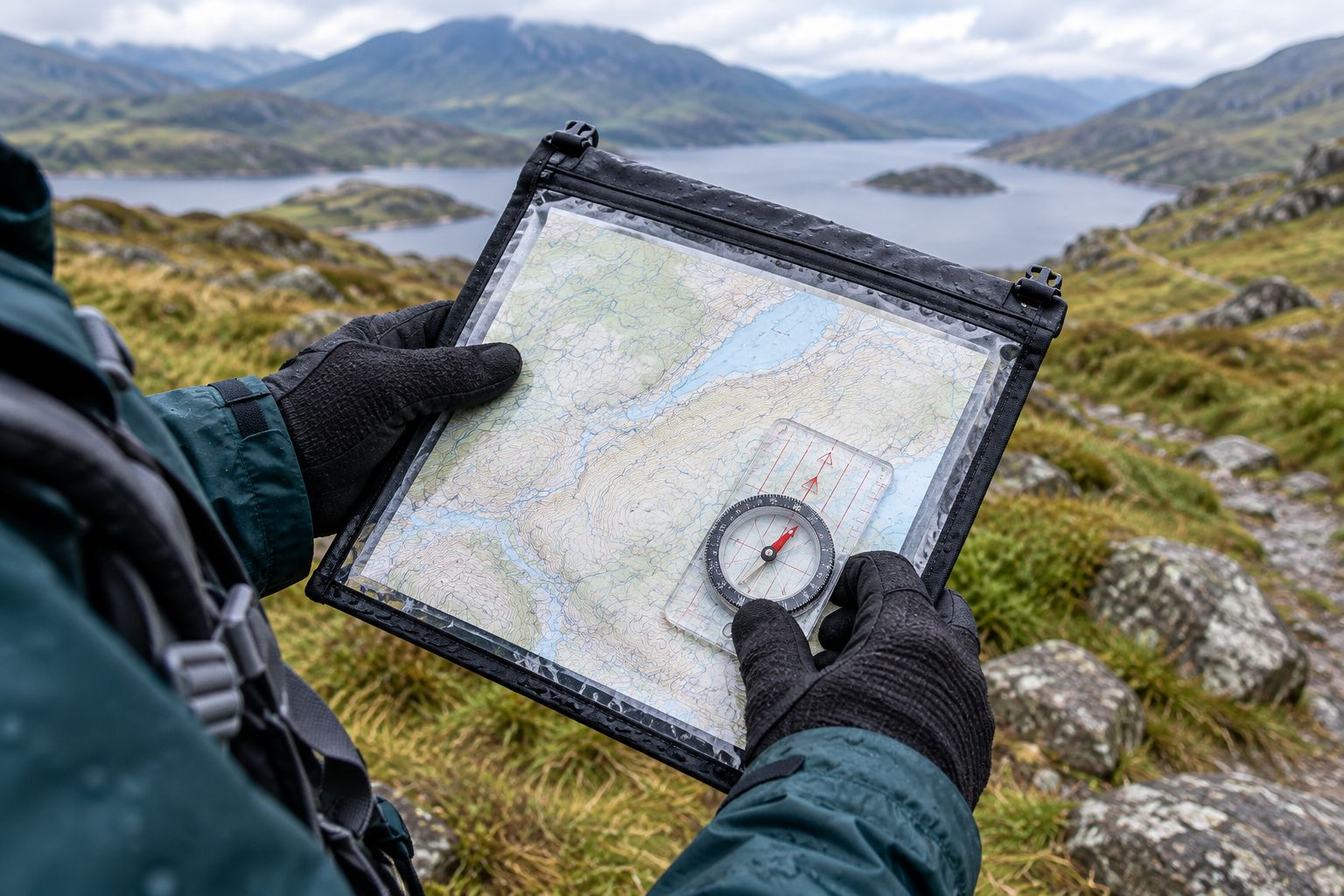
Put your baseplate compass over the map while it is inside the case. Check that the grid lines, compass markings and route detail remain readable through the layers. Stop and use a stable position rather than trying to take a bearing while walking.
At a 1:25,000 scale, 1 cm on the map represents 250 m on the ground. At 1:50,000, 1 cm represents 500 m. A fold hiding a small piece of paper can therefore hide meaningful route information.
Keep the map flat where you need to use the compass. Thick folds and raised seams make it harder to align the baseplate cleanly with the printed detail.
Check the closure before every walk
Waterproof performance depends on the case being closed as instructed. Inspect the seams, clear panel and sealing area before loading your map. Replace a damaged case rather than relying on tape over a split as your only protection.
For a new case, follow the manufacturer’s leak-check instructions with disposable paper inside instead of your main map. Do not invent an immersion test for a case rated only for another form of exposure.
Use this routine throughout your 2026 walking season:
- Load dry paper into a dry case.
- Keep dirt out of the sealing area.
- Close the entire seal, including the ends.
- Refold the map somewhere sheltered when possible.
- Dry the case inside and out after use.
Carry the working map where you can reach it without unpacking everything. Keep backup paperwork protected separately. Neither arrangement replaces the need to know how to use the map.
How the designs are ranked
The order prioritises reading the map while it stays enclosed, then usable viewing area and practical handling. That puts the double-sided case first for regular route checks and reserves the storage-focused pouch for spare paperwork.
This 2026 ranking is a design buying guide, not a product test. No model earns a waterproof claim from its shape alone. Check the individual specifications before choosing.
Which waterproof map case should you choose?
Choose a double-sided waterproof map case unless your main need is storing spare sheets. Match the window to your folded route, check the closure instructions and try the handling with your walking gloves.
Choose a compact pouch for a small working section. Choose a large-format case when seeing more terrain matters more than compact handling. Keep a roll-top document pouch for backup maps if opening it repeatedly would interrupt your route checks.
FAQ
What’s the best waterproof map case for hillwalking in Ireland?
A double-sided waterproof map case is the default choice for frequent route checks. Choose a model with clear sealing instructions and enough usable window space for your route and nearby terrain.
Should I choose an A4 or A5 map case?
Choose the case that fits your folded map inside its usable window. A4 paper measures 210 × 297 mm and A5 measures 148 × 210 mm, but a case’s outer dimensions do not prove its internal capacity.
Is a roll-top pouch better than a clear map case?
A roll-top pouch suits spare-map storage; a clear map case suits reading your working map. An opaque roll-top pouch requires opening before you can inspect the contents.
Can I use a compass through a waterproof map case?
Use a baseplate compass over the enclosed map only when the map and compass markings remain readable and you can keep the working section flat. Thick folds and raised seams interfere with alignment.
Does a waterproof map case protect against immersion?
Immersion protection depends on the individual case’s declared rating and instructions. Do not assume a rain-protection claim also covers submersion.
Can I use a stationery wallet as a waterproof map case?
Do not rely on a stationery wallet as waterproof protection unless its manufacturer explicitly specifies that use. A clear panel and a zip do not establish a watertight seal.
How should I check a new waterproof map case?
Follow the manufacturer’s leak-check instructions using disposable paper rather than your main map. Inspect the closure and seams, and avoid exposure beyond the case’s stated protection.
One last thing
Show your way back, not just your way up. Before leaving, fold the map so you can see return options and useful surrounding terrain without opening the case. A dry map with the relevant section hidden is still difficult to use.