

Can you keep pike you catch in Ireland?
Yes, in the Republic of Ireland you can generally keep one pike per day, provided it measures no more than 50 cm, subject to any stricter rules on the water you fish. Pike over 50 cm must be returned, possession limits also apply, and you must check separate regulations before fishing in Northern Ireland.
- Can you keep pike you catch in Ireland? Yes: the Republic’s general limit is one daily, no longer than 50 cm.
- Inland Fisheries Ireland lists separate limits for keeping whole pike and possessing pike flesh.
- Pike fishing permits and local fishery rules can restrict retention further; check before your trip.
- Prepare for catch and release even if you intend to retain a legally permitted fish.
Can you keep pike you catch in Ireland?
In the Republic of Ireland, the general national rule allows you to kill no more than one pike per day, and that pike must not exceed 50 cm. Inland Fisheries Ireland’s pike regulations summarise these restrictions under the Protection of Pike Bye-law No. 809, 2006. The same rules place limits on possession, so the daily allowance is not permission to accumulate fish.
For a 2026 fishing trip, check Inland Fisheries Ireland’s current regulations and the rules for your chosen water before deciding to keep anything. A national allowance does not override a fishery’s catch-and-release requirement.
| Situation | General rule in the Republic of Ireland | Your next move |
|---|---|---|
| First pike of the day, no longer than 50 cm | Retention is permitted within national limits, unless stricter rules apply | Check the fishery rules and possession limits first |
| Pike longer than 50 cm | You cannot kill it under the general national rule | Unhook and return it carefully |
| Another pike after you have already killed your daily allowance | You cannot kill another that day | Return it |
| You intend to carry several whole pike home | The daily allowance does not remove possession restrictions | Do not accumulate retained fish |
| You are fishing in Northern Ireland | Different regulations apply | Check the authority responsible for that water |
Prepare for returning fish before you cast. Our guide to unhooking mats for safe pike and carp handling explains a useful part of that setup.
Why this matters
The question is not simply whether pike are edible or whether you caught the fish yourself. Length, daily retention, possession and local permission are separate checks. Passing one does not mean you pass the others.
A pike over the permitted length does not become legal to keep because it is your first catch. Equally, a smaller pike does not become legal to retain because another angler says the lake has plenty of them.
For your 2026 trip, decide on your approach before arriving. Planning to release every pike avoids the need to choose a fish for retention, but you still need suitable tackle and careful handling.
Pike no longer than 50 cm: check every condition
A pike measuring exactly 50 cm falls within the national length threshold. That does not create an automatic entitlement to take it home: you must also remain within the daily and possession limits, and the water must allow retention.
Measure the fish rather than judging its size from a photograph or comparing it with your landing net. Keep a suitable measuring mat or board ready, and minimise handling while you establish its length.
Use this check before retaining a smaller pike:
- You are fishing under the Republic of Ireland’s applicable rules.
- The fish measures no more than 50 cm.
- You have not already killed a pike that day.
- Retention is permitted by the fishery’s conditions.
- Keeping it will not breach the possession restrictions.
If you cannot establish that retention is permitted, return the fish. Do not keep it while you look for an answer later.
Pike over 50 cm: return the fish
Pike longer than 50 cm are protected from killing under the general national rule. This is an upper length limit, not a minimum size that fish must reach before you can take them.
That distinction matters. Anglers familiar with minimum-size rules for other species must not apply the same assumption to pike.
A large pike is a catch to handle carefully and return, not a larger version of the daily allowance. Have your landing net, unhooking tools and wet mat ready so you do not need to organise equipment with the fish already out of the water.
Do not interpret a difficult unhooking situation as permission to ignore the length restriction. Get help from an experienced pike angler when you need it, and ask Inland Fisheries Ireland for guidance on exceptional situations rather than inventing an exemption.
Possession: one whole pike or 0.75 kg of flesh
Inland Fisheries Ireland’s summary of the pike bye-law also restricts possession to one whole pike no longer than 50 cm, or no more than 0.75 kg of pike flesh, under the general rules. This is a separate restriction from the daily killing limit.
The practical point is straightforward: do not read “one per day” as permission to build up a collection of whole pike over a fishing holiday. Filleting a fish is not a way around the rules either; pike flesh has its own possession limit.
Keep the distinction clear when planning a 2026 trip:
- Daily killing limit: controls how many pike you can kill that day.
- Length restriction: controls which pike you can legally kill.
- Possession restriction: controls what you can hold, not just what you caught today.
If you intend to transport or store retained pike, read the current official wording before doing so. Do not rely on an informal explanation about freezer storage, shared bags or dividing fish between passengers.
Why permission to keep pike varies
The national limit is only part of the decision. These factors determine which rules you need to follow:
- Jurisdiction: Republic of Ireland regulations are not a substitute for Northern Ireland regulations.
- The particular water: check whether additional bye-laws or restrictions apply to the lake or river.
- Fishery conditions: a managed fishery or club can require catch and release as a condition of fishing.
- Permit conditions: permission to fish does not necessarily include permission to retain your catch.
- Your retained catch: the fish’s length, your daily allowance and what you already possess all matter.
Ask a precise question when checking a venue: “Does this water allow pike retention, and are there any restrictions beyond the national rules?” That gets a more useful answer than asking only whether pike fishing is allowed.
Keep the permit conditions accessible during your session. A general guide cannot replace instructions that apply specifically to the water in front of you.
How do you prepare to release a pike safely?
Prepare for release before your first cast, even when retention is permitted. You cannot know in advance whether the next fish will exceed 50 cm or whether you will need to return it for another reason.
Use a simple sequence:
- Prepare equipment. Put your landing net, wet unhooking mat, long forceps or pliers, hook cutters and measuring equipment within reach.
- Check conditions. Choose a safe landing and release point before fishing, rather than searching for one with a hooked fish.
- Unhook carefully. Keep the fish supported, avoid the gills, and use suitable tools instead of putting fingers near hooks and teeth.
- Measure briefly. Have the measuring surface ready and avoid unnecessary time out of the water.
- Release carefully. Support the pike in the water and let it swim away when it has recovered its balance.
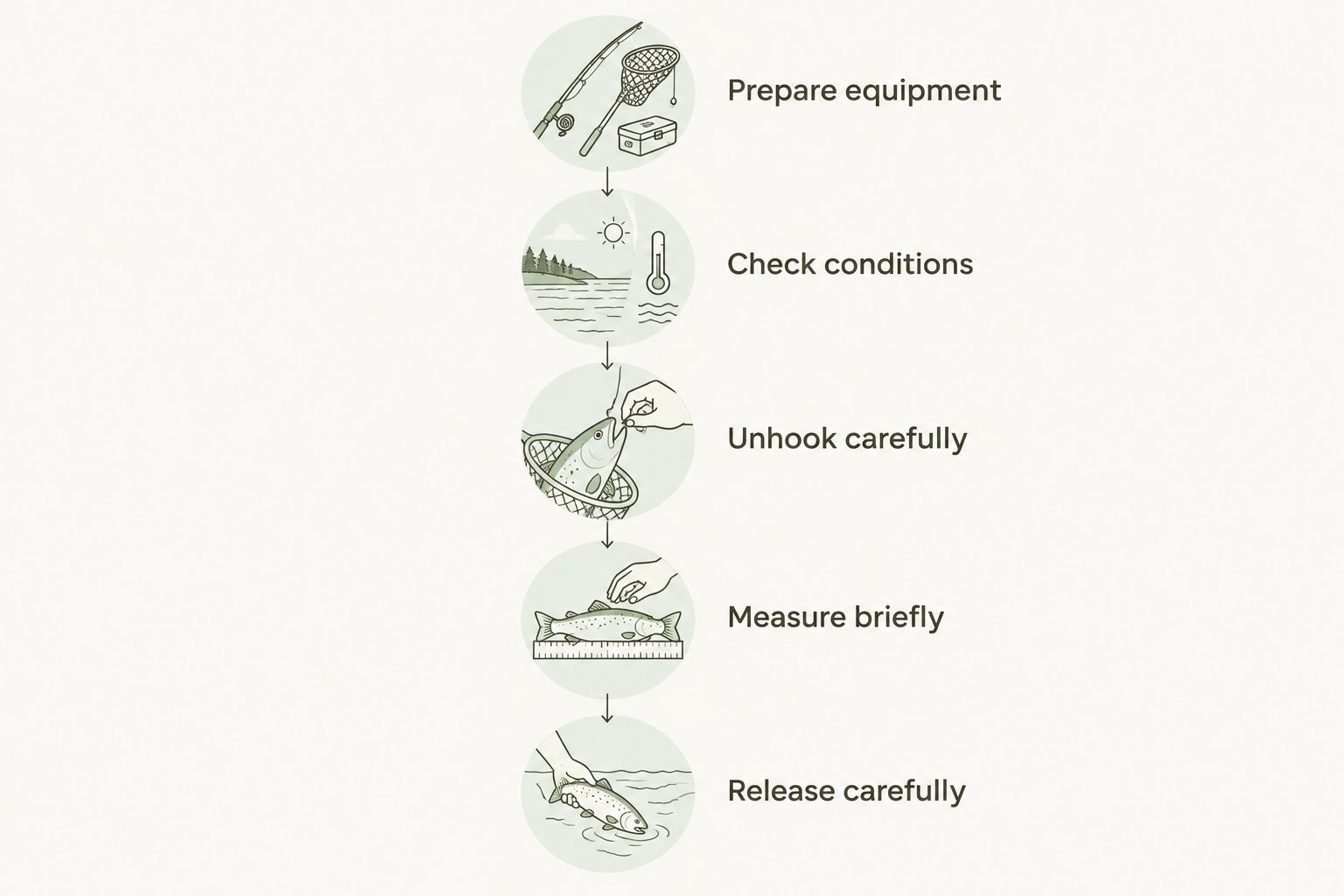
If you are new to pike fishing, go with someone experienced in handling them. Reading the sequence helps you prepare; it does not replace a practical demonstration of safe support and unhooking.
We recommend putting pike-handling equipment ahead of extra lures when preparing your first session. The benefit is readiness when a fish needs returning; the limitation is that equipment alone does not teach handling technique.
Can I keep a pike if I am fishing for food?
One pike per day, no longer than 50 cm, remains the general national limit regardless of whether you intend to eat it. Food use does not remove the length restriction, possession limit or local conditions.
Legal retention and food safety are different questions. Permission to retain a fish is not evidence that fish from a particular water are suitable to eat; check any relevant local food-safety or pollution advice separately.
Can I keep a pike caught on private or club water?
The 50 cm national threshold is not replaced by permission from a landowner or club. You must comply with the applicable law as well as the conditions attached to your access or permit.
A catch-and-release condition means you must return the pike even when it falls within the general national retention allowance. Confirm the rules before paying for or starting your session.
Do the same pike rules apply in Northern Ireland?
The Republic’s 50 cm threshold must not be treated as an all-island rule. Northern Ireland has separate fisheries regulations, and the responsible authority depends on where you fish.
Check current guidance from the Department of Agriculture, Environment and Rural Affairs or the Loughs Agency, as appropriate to the water. For a cross-border trip in 2026, check each destination separately rather than carrying one set of assumptions between them.
What should you check before leaving home?
Start with the exact lake or river, not just the county. Establish which authority covers it, whether you need permission or a permit, and whether retention is allowed.
Then read the current official pike regulations. Inland Fisheries Ireland is the starting point for the Republic’s national pike rules; the fishery manager or club supplies the conditions attached to access.
Save those details before travelling. For your 2026 checklist, include the water’s name, permit conditions, release requirements and an appropriate contact for questions.
Do not treat an old forum discussion, a social-media comment or another angler’s previous visit as confirmation. If the official and local information leave you uncertain, ask before fishing and plan to release your catch.
FAQ
Can you keep pike you catch in Ireland?
Yes, in the Republic of Ireland the general national rule permits one pike per day, provided it is no longer than 50 cm. Possession limits and stricter rules for the particular water also apply.
Is 50 cm the minimum size for keeping a pike?
No, 50 cm is the upper length threshold under the Republic’s general national pike rule. Pike longer than 50 cm must be returned, not retained.
How many pike can I take home in a day?
The general national daily killing limit in the Republic of Ireland is one pike, no longer than 50 cm. You must also comply with possession restrictions and any catch-and-release conditions.
Can I keep a pike that measures exactly 50 cm?
A pike measuring exactly 50 cm falls within the national length threshold. Retention still depends on your daily allowance, possession limits and the rules for that water.
Can I keep more pike if I fillet them?
No, filleting does not remove the possession restriction: the general limit includes no more than 0.75 kg of pike flesh. It does not cancel the daily killing limit or the length restriction.
Does a fishing permit mean I can keep pike?
No, a fishing permit does not automatically permit pike retention. Read its conditions alongside the national regulations and any rules specific to the water.
Where should I check pike fishing rules for a 2026 trip?
Check Inland Fisheries Ireland for the Republic’s national pike regulations, then check the particular fishery’s conditions. For Northern Ireland, consult the responsible authority, including DAERA or the Loughs Agency as appropriate.
One last thing
The easiest rule to misread is the length limit: a bigger pike is not a more eligible fish to keep. The national threshold works in the opposite direction to a minimum-size rule.
Put your measuring equipment beside your unhooking tools, not at the bottom of your tackle bag. You should be ready to return a pike before you ever need to decide whether retention is allowed.