

Kayaks ranked by weight capacity for Irish anglers 2026
Best overall: an adult fishing kayak with a confirmed kayak weight limit that covers you and your complete kit. Best for powered fishing: a motor-compatible kayak rated for the full fitted load. Best for shared trips: a tandem with a confirmed combined capacity. For your 2026 shortlist, compare documented carrying capacity first—not hull length, bundle contents or motor thrust.
- The kayak weight limit must cover the paddler and everything carried aboard, following the manufacturer’s definition.
- We recommend choosing fishing kayaks by confirmed loaded capacity before comparing rod holders, seats or electronics.
- The 9ft Discovery and 6ft kids kayak dimensions do not establish their carrying capacities.
- Motorised kayak setups need the battery, motor, bracket and fishing kit included in the load check.
Why this matters
A kayak carries more than your body weight. Clothing, safety equipment, drinking water, tackle and fitted accessories all contribute to the load, so choosing a boat solely against your weight leaves out part of the calculation.
A maximum load rating is a limit, not a target to pack towards. It also does not establish that a kayak suits exposed water, strong current or your level of experience. If you are choosing your first boat, start with our guide to kayaks for beginners in Ireland alongside the capacity checks below.
A useful capacity ranking needs comparable manufacturer ratings for each exact model. Without those figures, putting one kayak above another would turn a buying guide into guesswork. The order below ranks buying priorities by fishing use, not unverified carrying capacities.
What makes the best kayak for your loaded weight?
Use these criteria for your 2026 shortlist before comparing extras:
- Confirmed capacity: Find the manufacturer’s rating for the exact model and check what that figure includes.
- Complete load: Count the paddler, clothing, safety equipment, tackle, provisions and fitted accessories.
- Suitable use: Check the manufacturer’s intended use rather than treating capacity as permission to launch anywhere.
- Load placement: Look for usable storage that allows you to follow the manufacturer’s loading instructions.
- Fit and control: Confirm that the seat, foot position and paddle reach suit you with your normal clothing on.
- Handling ashore: Check the kayak’s own weight separately from its carrying capacity, including how you will lift and transport it.
Keep these checks separate. A kayak that is easy to lift does not automatically have a low carrying capacity, and a high load rating does not automatically make a kayak easy to paddle.
Kayak choices at a glance
| Priority | Kayak choice | Best for | Standout feature | Key limitation |
|---|---|---|---|---|
| 1 | Adult paddle fishing kayak | Solo anglers carrying a straightforward fishing setup | No propulsion battery or motor to include | Exact loaded capacity still needs confirmation |
| 2 | Motor-compatible fishing kayak | Anglers planning an electric motor installation | Supports a powered setup when expressly approved | Motor, battery and mounting equipment add to the load |
| 3 | Tandem kayak | Two paddlers sharing a trip | Seating intended for two occupants | Both paddlers and all equipment share the capacity |
| 4 | Junior sit-on-top kayak | Children using an appropriately rated kayak | Child-focused format | Not an adult fishing substitute |
Use this table to choose the right format, then rank individual models by confirmed capacity. Do not assign a kilogram figure from appearance, length or the number of seats.
1. Adult paddle fishing kayak: best for a simple solo setup
An adult paddle fishing kayak is the first format to assess when you want to fish without fitting a motor. You still need to account for everything aboard, but there is no propulsion battery, motor or motor bracket in that calculation.
The 9ft Sit On Top Fishing Kayak Bundle – Discovery Kayak with Paddle, Seat & Yellow Life Jacket identifies a fishing kayak and its included equipment. Its 9ft length does not establish a carrying capacity, and the included life jacket still needs to suit the wearer.
Adult paddle fishing kayak pros:
- No motor installation to assess.
- No propulsion battery to include in the load.
- Lets you plan around your actual paddle-fishing equipment.
Adult paddle fishing kayak cons:
- Fishing accessories still reduce the capacity left for other equipment.
- Hull length alone cannot confirm suitability for a heavier paddler.
Best for: Solo anglers who want a paddle-driven fishing setup with limited fitted equipment.
Verdict: Hold until the exact kayak’s capacity and intended use are confirmed. For a 2026 purchase, match the specification to the model you are buying rather than relying on a similar-looking boat.
2. Motor-compatible fishing kayak: best for a powered setup
Choose a motor-compatible kayak only after checking that the manufacturer permits the proposed installation. A large carrying-capacity figure does not, by itself, approve a motor bracket, battery position or particular propulsion system.
The Minn Kota | Kayak Terrova Trolling Motor | 36" Shaft | 55Lb | 12V illustrates why specification labels need careful reading. The 55lb figure describes motor thrust, while 12V describes the electrical system; neither figure tells you the motor’s mass or the kayak’s payload.
Motor-compatible fishing kayak pros:
- Accommodates powered fishing when the installation is approved.
- Lets you assess the whole fitted setup before buying accessories.
- Provides a clear equipment list for your load calculation.
Motor-compatible fishing kayak cons:
- The motor, battery, bracket and cables contribute to the carried load.
- Capacity approval and mounting compatibility are separate checks.
- A bare-hull comparison leaves out equipment needed for powered use.
Best for: Anglers committed to an expressly approved electric-motor setup.
Verdict: Hold until both the loaded capacity and installation compatibility are confirmed. We recommend making those checks before choosing a battery or mounting bracket, not after.
3. Tandem kayak: best for two paddlers sharing the load
A tandem kayak needs to accommodate both paddlers and everything carried aboard. Do not compare its total capacity with a solo kayak without also comparing the total intended load.
Check any separate seating or occupant restrictions in the manufacturer’s instructions. A combined load below the overall maximum does not cancel a stated restriction for a particular seat or loading position.
Tandem kayak pros:
- Provides a format intended for two paddlers.
- Allows shared equipment to be planned as one combined load.
- Suits trips where paddling together is the main requirement.
Tandem kayak cons:
- Two occupants use the same overall carrying allowance.
- Seat allocation and load placement need checking.
- A higher total capacity does not necessarily leave more space for fishing kit.
Best for: Pairs who want to paddle together and can verify the fully loaded arrangement.
Verdict: Hold until the combined load and seating requirements are checked. Do not choose a tandem purely because its headline capacity exceeds a solo model’s figure.
4. Junior sit-on-top kayak: best for a child-sized setup
A junior kayak belongs in a separate comparison from adult fishing kayaks. Match the child, equipment and intended activity to the manufacturer’s rating; do not treat a compact hull as a convenient adult alternative.
The Kids Sit on Top 6ft Kayak | Paddle included is described as having a 180cm hull, approximately 15kg hull weight and 80cm width. Those measurements help you assess storage and handling, but none establishes its carrying capacity.
Junior sit-on-top kayak pros:
- Provides a child-focused kayak option.
- Includes a paddle in the named product.
- Has stated dimensions to help assess storage space.
Junior sit-on-top kayak cons:
- Dimensions cannot replace the occupant or load rating.
- The included paddle still needs checking for the child’s fit.
- It is not an adult fishing recommendation.
Best for: Children using a kayak confirmed as suitable for their size and activity.
Verdict: Skip for adult angling; hold for junior use until the rating and fit are confirmed.
How to calculate your complete kayak load
Build your 2026 load check around the equipment you will actually take. We recommend weighing packed bags rather than estimating their contents from memory.
Weigh the paddler
Record your weight with the clothing, footwear and personal safety equipment you intend to wear. If you weigh those items separately, do not count them again in your equipment total.
Pack the kit
Include rods, reels, tackle, bait, landing equipment, food, drinking water, spare clothing and communication equipment. Count the bags and containers as well as what is inside them.
Add fitted equipment
Include removable seats, storage boxes, rod holders, electronics and mounts according to the manufacturer’s definition of load. For powered setups, include the motor, battery, bracket and associated equipment.
Check the rating
Compare your complete total with the exact model’s published capacity. Follow the manufacturer’s explanation of whether its figure describes payload or a different total; do not subtract the hull weight unless the stated definition requires it.
Check the layout
Follow the loading instructions for where equipment belongs. Staying below a total weight limit does not make every arrangement suitable, particularly when equipment obstructs movement or is concentrated in one position.
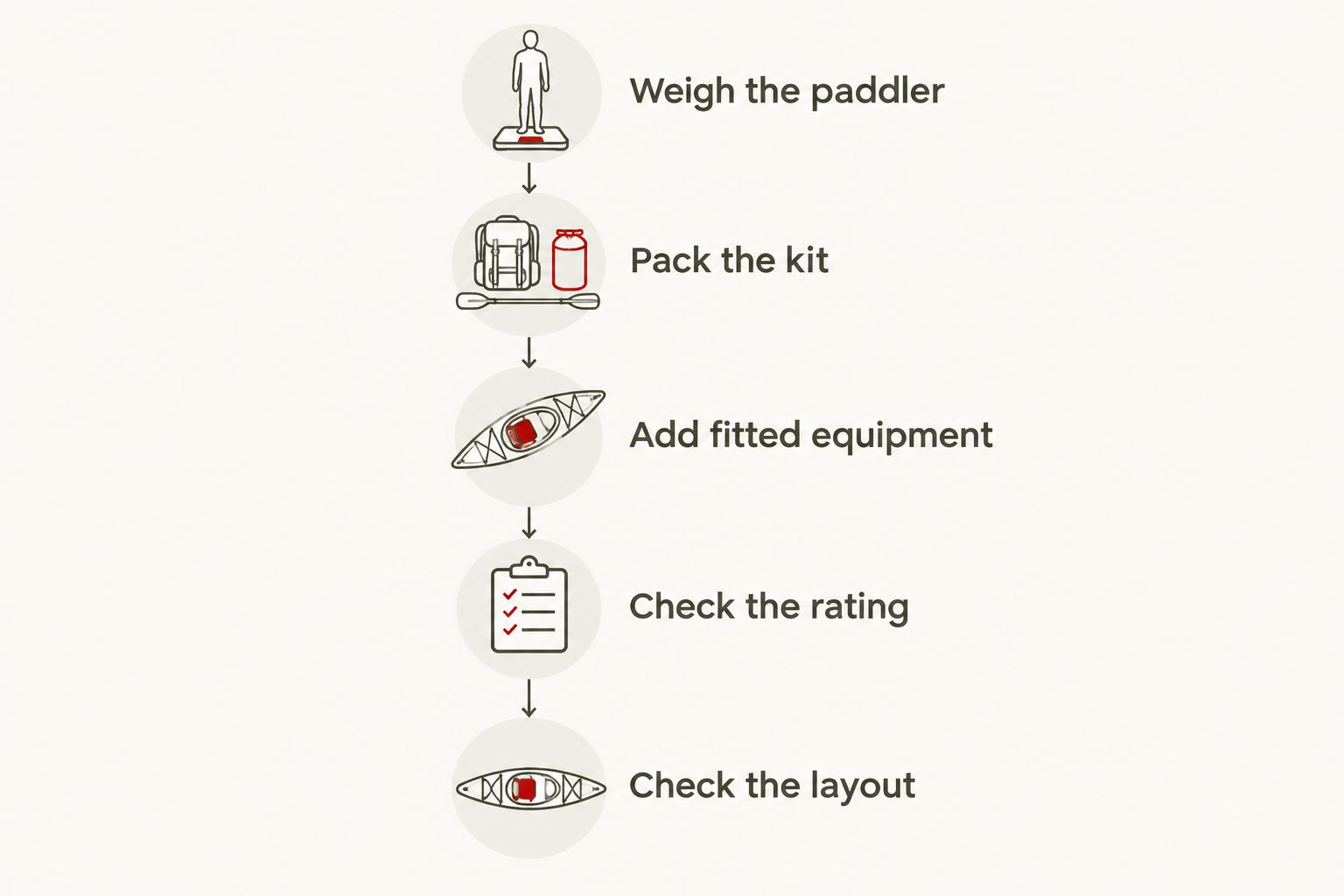
Keep a written load list with your kayak details. Update it whenever you change the seat, battery, motor or normal fishing equipment, rather than assuming an earlier calculation still applies.
How to rank actual kayaks by capacity in 2026
Create a shortlist with the exact model name, stated capacity, capacity definition, hull weight and intended use. Compare like with like: a payload figure and a total-loaded-weight figure are not interchangeable without understanding their definitions.
Rank confirmed capacities from highest to lowest only after checking those definitions. Then remove models that do not suit your intended water, seating needs, transport arrangements or approved accessory setup.
Use this comparison record:
- Model: Exact name and version.
- Capacity: Published figure with its unit and definition.
- Your load: Complete paddler and equipment total.
- Conditions: Manufacturer’s intended use and restrictions.
- Fit: Seating, foot position and access to essential equipment.
The largest capacity is not automatically the best fishing kayak. The useful choice is a suitable model that accommodates your complete load without forcing you to remove essential safety equipment.
How we rank these choices
The buying order prioritises a straightforward adult fishing setup, then powered use, shared paddling and junior use. Each option serves a different buyer; it is not a claim that one format always carries more than another.
A numerical model ranking needs verified, comparable carrying capacities. Neither a 9ft hull length nor an approximately 15kg hull weight supplies that information, so neither receives a fabricated payload figure here.
Which kayak should you choose?
Choose an adult paddle fishing kayak as your default shortlist if you fish solo and do not need a motor. Confirm its capacity against your dressed weight and packed kit, then check fit, intended use and transport.
Choose a powered setup only when its installation is approved and the complete equipment load is accounted for. Choose a tandem for two paddlers, and keep junior kayaks in a separate child-focused decision.
For your 2026 purchase, settle the capacity question before adding optional equipment. We recommend asking for the exact model’s capacity definition whenever a product description gives dimensions but leaves the load rating unclear.
FAQ
What does a kayak weight limit include?
A kayak weight limit must be interpreted using the manufacturer’s definition for that exact model. For a payload rating, account for the paddler and carried equipment, including fitted accessories where specified.
What is the best kayak weight limit for a heavier angler?
The right kayak weight limit covers the angler’s dressed weight and complete fishing setup while meeting the manufacturer’s loading instructions. Body weight alone is not enough to choose a suitable kayak.
Can I rank kayaks by their length?
No, kayak length does not establish carrying capacity. Compare the published capacity of each exact model rather than assuming a longer kayak always carries more.
Does a kayak motor’s thrust tell me how much weight it adds?
No, thrust is not the motor’s mass. Use the motor’s actual weight, then include the battery, mounting equipment and cables in the kayak load calculation.
Does the kayak’s own weight count towards its capacity?
That depends on how the manufacturer defines the capacity figure. Check whether the specification describes payload or another loaded-weight measure before adding or subtracting hull weight.
Can I use a fixed percentage of maximum capacity as a safe load?
Do not substitute a general percentage for the manufacturer’s instructions. Follow the exact model’s loading guidance and intended-use restrictions, and assess the conditions separately.
Is a tandem kayak better for a heavier solo angler?
A tandem is not automatically better for a heavier solo angler. Confirm that solo use is permitted, check the seating arrangement and compare the complete load with the manufacturer’s rating.
Does staying below the weight limit make a kayak suitable for Irish coastal fishing?
No, staying below the weight limit does not establish coastal suitability. Check the kayak’s intended use alongside your skills, safety equipment, forecast and planned launch conditions.
One last thing
Check the load on the car separately from the load on the water. A kayak’s carrying capacity is not a roof-load rating, and the boat’s own weight still matters when lifting and transporting it.
Before buying, write down both checks: the complete fishing load aboard and the transport load supported by your vehicle and rack system. Passing one does not mean the other is correct.