

Best dog cooling mats for working dogs in summer
Best overall: a sealed gel dog cooling mat for supervised rest. Best for a fixed rest area: a water-filled mat. Best for lightweight outdoor packing: an evaporative mat. We recommend choosing by your dog's behaviour and resting space, not by cooling claims alone; this 2026 guide explains the strengths and limits of each type for working dogs in Ireland.
- A sealed gel dog cooling mat is our default for supervised summer rest, provided your dog does not chew bedding.
- Water-filled cooling mats suit fixed rest areas where filling, checking and emptying are practical.
- Evaporative mats need water and airflow; humid conditions limit evaporation.
- Cooling mats support rest. They do not make a hot vehicle safe or treat heatstroke.
Why this matters
A working dog needs a proper break from activity. A cooling mat gives your dog a resting surface that can absorb heat, but its usefulness depends on the material, the surroundings and whether your dog actually lies on it.
Shade, drinking water and reduced exertion come first. A mat is an extra, not permission to keep working through warm conditions. Plan summer 2026 outings around your dog's condition rather than a fixed exercise target.
Mats work while your dog rests. Wearable options serve a different purpose; our guide to dog cooling vests for working dogs in summer explains that alternative.
What makes the best dog cooling mat?
Use these criteria before choosing a type. A useful mat must fit both your dog and the place where you expect it to rest.
- Cooling method: Check whether the mat uses gel, water or evaporation. Each needs different preparation and care.
- Resting fit: Compare the usable surface with your dog lying naturally on its side. Size labels alone are not enough.
- Damage risk: Read the construction details and inspect seams. A dog that chews or digs needs close supervision around filled mats.
- Cleaning: Check how you remove mud, hair and moisture without damaging the cover or filling.
- Placement: Choose a flat, shaded space where the mat stays stable and your dog can leave it freely.
- Reset requirements: Read how the mat returns to its intended starting condition. Do not assume continuous cooling.
Avoid choosing on appearance alone. A thick mat is not automatically cooler, and a soft cover is not automatically suitable for claws. Check the actual care instructions before use.
Dog cooling mats at a glance
These rankings compare cooling methods, not named products. Within each type, construction and instructions determine suitability.
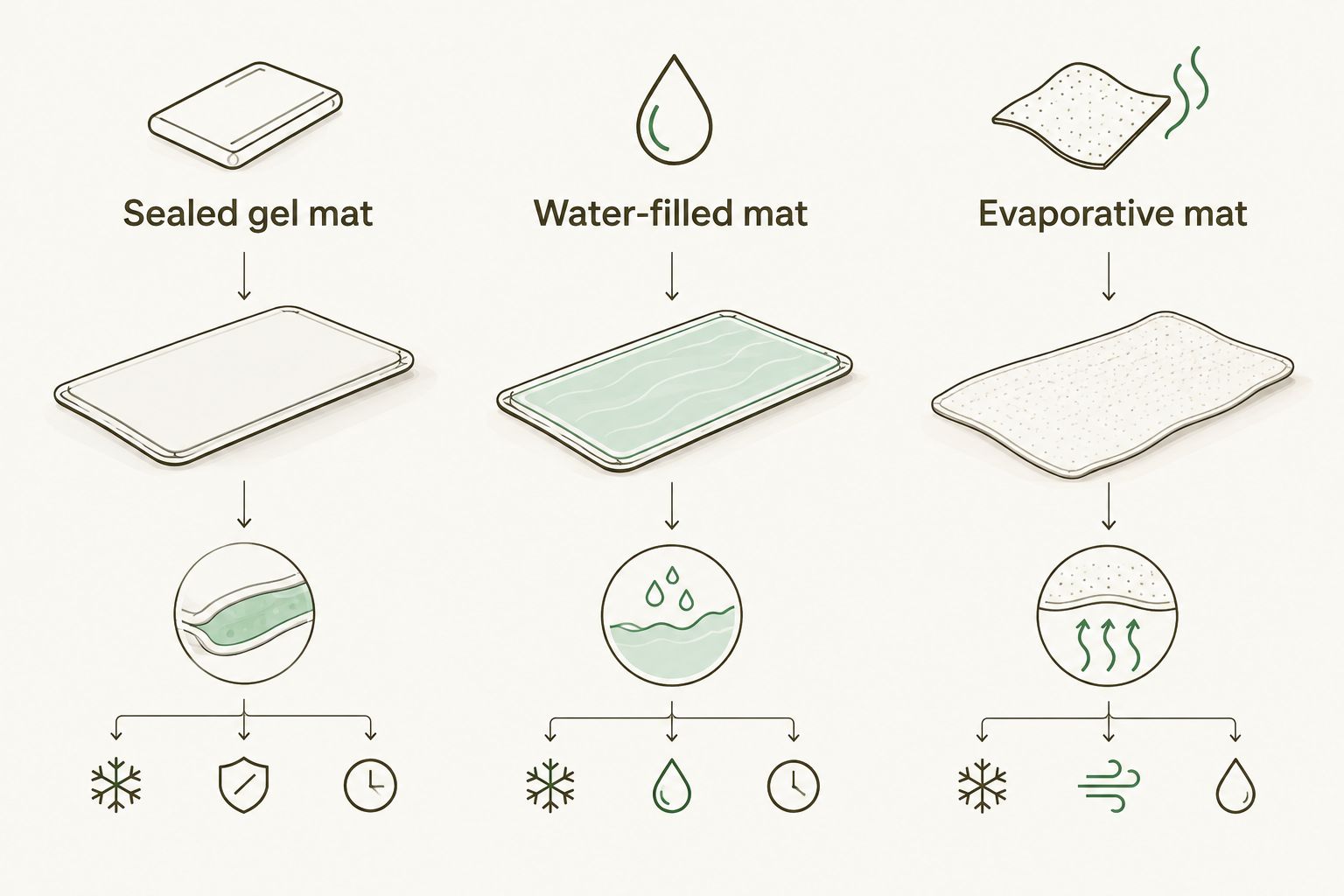
| Mat type | Best for | Standout feature | Key limitation |
|---|---|---|---|
| Sealed gel mat | Supervised rest between activities | No routine filling for sealed designs | Punctures damage the sealed filling; cooling is finite |
| Water-filled mat | A fixed home or kennel rest area | Water absorbs heat from contact | Filling, leaks and moving the filled mat need attention |
| Evaporative mat | Lightweight packing for outdoor breaks | Uses evaporation from damp material | Needs wetting and airflow; humidity reduces evaporation |
Choose the cooling method you can manage reliably. A mat that needs preparation is a poor match if you cannot provide that preparation during a day outdoors.
1. Sealed gel mat: best for supervised breaks
A sealed gel mat contains a filling that absorbs heat when your dog lies against it. Many designs need no filling with water, but activation and reset instructions vary. Read the instructions for the particular mat rather than assuming all gel mats work identically.
This is our default dog cooling mat choice for supervised summer breaks. You can place it in a shaded resting spot without managing a fill valve. It still needs inspection and a suitable ambient environment.
Sealed gel mat pros:
- No routine water filling for sealed designs.
- Straightforward placement on a flat resting surface.
- No wetting step for designs intended for dry use.
- A practical format when you move between supervised rest spots.
Sealed gel mat cons:
- Teeth, claws or sharp ground can puncture the cover.
- The filling warms during use; cooling does not continue indefinitely.
- Cleaning and folding rules depend on the individual design.
For summer 2026, check the seams before packing and again after use. Keep the mat away from thorns, sharp gravel and protruding crate fittings. Do not treat a non-toxic filling claim as permission for your dog to chew it.
Best for: A dog that settles on bedding without biting or digging at it, with a handler nearby.
Verdict: Buy this type for supervised breaks if the construction, fit and care instructions suit your dog.
2. Water-filled mat: best for a fixed rest area
A water-filled dog cooling mat uses water as its heat-absorbing medium. You fill it according to its instructions and place it where your dog rests. As the water takes in heat, it warms; the mat is not an endless cold surface.
A fixed shaded area makes the filling and checking routine easier. You do not need to carry the filled mat between every stop, and you can inspect the surface beneath it for leaks.
Water-filled mat pros:
- Suits a resting spot near a water supply.
- Uses water as the heat-absorbing filling.
- Gives you a defined fill-and-check routine before use.
Water-filled mat cons:
- A damaged valve or cover can leak.
- Water adds weight when you move the filled mat.
- Filling and emptying add preparation and storage work.
Check the manufacturer's filling instructions before adding anything to the water. Do not improvise with additives or freeze the mat unless its instructions expressly allow it. Leave the valve out of your dog's reach where the design permits.
Best for: A supervised home, yard or kennel rest area with shade and a practical filling point.
Verdict: Buy this type for a fixed rest area; skip it when frequent carrying is central to your day.
3. Evaporative mat: best for lightweight outdoor packing
An evaporative dog cooling mat uses damp material. As water evaporates, it takes heat from the material and its surroundings. Airflow helps that process; humid conditions reduce it.
This type suits handlers who can wet the mat and lay it out in an airy, shaded spot. Ireland's changeable weather makes the conditions at the resting place more important than the season on the calendar.
Evaporative mat pros:
- Uses water rather than a sealed gel filling.
- Can suit packing where a fabric-style format is useful.
- Lets you prepare the resting surface where water is available.
Evaporative mat cons:
- Needs wetting according to the product instructions.
- Loses its evaporative function as it dries.
- Humid air and poor airflow limit evaporation.
For 2026 trips, plan where you will wet and dry the mat. Do not leave damp fabric packed away after an outing. Clean it as directed and allow it to dry before storage.
Best for: Supervised outdoor rest with water available and air moving around the mat.
Verdict: Buy this type when you can manage wetting and drying; skip it for a stuffy enclosed resting space.
Get the fit right before you buy
Measure your dog while it lies in its normal resting position. Record the length and width of the space its body occupies, then compare those measurements with the mat's usable surface. Include the position your dog chooses when stretched out, not just when curled tightly.
For a crate, measure the floor separately. The mat must lie flat without curling up the sides, covering ventilation openings or interfering with the door. Our guide to choosing the right dog crate size for transport covers the enclosure itself.
Do not force a mat into a space that is too small. Folding or bending it changes the resting surface and can damage a design not intended for that treatment. If your dog cannot choose to move away, rethink the setup.
Set up a safe summer rest spot
Introduce the mat at home before taking it into the field. Let your dog investigate it in a quiet, cool setting. Reward calm use, but do not hold your dog on the mat or make it the only resting option.
Follow this sequence whenever you set it out:
- Find shade: Choose a spot away from direct sun and hot ground.
- Check the mat: Look for splits, exposed filling, damaged seams or leaks.
- Prepare correctly: Follow the filling, wetting or reset instructions for that design.
- Offer a choice: Keep another suitable resting surface available.
- Watch your dog: Check comfort and behaviour rather than assuming the mat is working.
A cooling mat does not make a parked vehicle safe. Never leave your dog in a hot vehicle with a mat as protection. Transport decisions must account for the temperature and ventilation of the whole space.
After use, lift the mat and check underneath. Moisture, grit and trapped debris need attention before the next rest break. Store the mat as directed rather than leaving it in a sun-heated vehicle.
When a cooling mat is the wrong answer
A dog that chews bedding is a poor candidate for an unattended filled mat. Remove a mat as soon as you see chewing, digging or damage. If filling is swallowed, contact your vet and keep the product information available.
A mat is also the wrong response to suspected heatstroke. Warning signs include excessive panting, marked drooling, weakness, vomiting, confusion or collapse. Treat those signs as urgent, not as a reason to wait for the mat to cool your dog.
Stop activity, move your dog out of the heat and begin cooling with water and airflow. Contact a vet immediately and follow their advice about transport. Do not delay veterinary help to see whether resting on a mat improves the situation.
Keep that distinction clear throughout summer 2026: cooling equipment supports sensible rest; it does not replace emergency treatment.
How the types are ranked
The ranking prioritises preparation, fit, damage risk, cleaning and placement. Sealed gel comes first for supervised breaks because it avoids routine filling. Water-filled comes next for a fixed rest area. Evaporative earns its place where wetting and airflow are practical.
These are use-case recommendations, not laboratory performance results. No cooling method wins in every setting. Your dog's behaviour can rule out a type before its cooling method matters.
Which dog cooling mat should you choose?
Choose a sealed gel dog cooling mat as the default for supervised rest, provided your dog leaves bedding intact. Choose water-filled for a fixed shaded area. Choose evaporative for outdoor breaks where you can manage water and airflow.
Before your first warm-weather outing in 2026, practise the entire rest setup at home. Check that your dog willingly uses the mat and can leave it. That tells you more about practical suitability than an unfamiliar mat introduced after exercise.
FAQ
What's the best dog cooling mat for a working dog?
A sealed gel dog cooling mat is the default choice for supervised rest if your dog does not chew bedding. Water-filled mats suit fixed rest areas, while evaporative mats suit breaks with water and airflow available.
Do dog cooling mats actually work?
Dog cooling mats can absorb heat through contact or use evaporation, depending on their design. Their effect depends on the surroundings, the mat's condition and whether your dog lies on it; they do not provide unlimited cooling.
Is a gel cooling mat better than a water-filled mat?
A sealed gel mat is easier to prepare when you want to avoid routine filling. A water-filled mat suits a fixed rest area where filling, emptying and checking for leaks are practical.
What size cooling mat does my dog need?
Choose a mat whose usable surface fits your dog lying naturally. Measure the resting footprint and any crate floor separately rather than relying on a small, medium or large label.
Can I put a dog cooling mat in a crate?
Use a cooling mat in a crate only when it fits flat, preserves ventilation and follows the product instructions. It does not make a hot vehicle safe, and your dog still needs supervision and a suitable environment.
Are cooling mats safe for dogs that chew?
Filled cooling mats are unsuitable for unattended use by dogs that chew bedding. Remove a damaged mat immediately and contact your vet if your dog swallows filling.
Does a cooling mat help a dog with heatstroke?
A cooling mat is not treatment for heatstroke. Stop activity, move the dog out of the heat, begin cooling with water and airflow, and contact a vet immediately.
One last thing
The best mat is useless if your dog refuses to lie on it. Introduce it during an ordinary rest at home, not for the first time after hard activity. Keep a choice of resting surfaces and build your summer routine around the dog, not the accessory.