

Best marine safety flares and signal kits for boat anglers in Ireland
Best overall: a mixed coastal signal kit matched to your boat and passage. Best for offshore trips: a kit that includes red parachute rockets. Best non-pyrotechnic backup: a marine electronic distress light. This 2026 guide compares marine safety flares and signal kits for boat anglers in Ireland by purpose, handling and limitations.
- For marine safety flares, we recommend matching the signal kit to your passage, not choosing by pack size.
- Red handheld flares help nearby rescuers locate you; orange smoke provides a daylight position marker.
- Offshore signal kits add red parachute rockets, but still need close-range signalling equipment.
- Electronic distress lights supplement pyrotechnics; do not assume they replace required flares.
Why this matters
A distress signal must do the right job. Raising an alert, marking your position and helping a rescue crew find your boat are different tasks. One device does not cover everything.
We recommend a mixed marine safety flares kit for Irish coastal boat anglers, selected against the actual passage and applicable requirements. Pair visual signals with a way to call for help. Our guide to marine VHF radios for boat anglers in Ireland covers that separate part of your boat safety setup.
This is a comparison of signal types, not a ranking of named flare brands. Choose the exact kit only after checking its contents, instructions, expiry dates and suitability for your vessel. A coastal label alone does not settle that decision.
What makes the best marine safety flares kit?
Use these criteria for your 2026 safety check. They matter more than the size of the container or the number of items pictured on its label.
- Signal purpose: Separate attention-getting signals from devices that mark your precise location.
- Day and night coverage: Orange smoke is a daylight signal. Red distress flares provide a different visual warning.
- Passage suitability: Match the kit to sheltered water, coastal passages or offshore trips, rather than your boat's length alone.
- Condition and expiry: Check each pyrotechnic device individually. Reject damaged items and arrange replacement of expired equipment.
- Safe handling: Read the manufacturer's instructions before departure. Different devices have different activation methods and hazards.
- Access and storage: Keep signals protected from moisture and heat, but reachable without unpacking your fishing gear.
No kit earns a recommendation just because it contains more flares. Extra devices are useful only when you know their purpose and can reach them during an emergency.
Marine safety flares and signal kits at a glance
| Ranked option | Best for | Standout feature | Key limitation |
|---|---|---|---|
| Mixed coastal signal kit | Coastal boat anglers building a complete visual signalling setup | Combines complementary signal types | Contents vary; the label does not establish suitability |
| Offshore kit with parachute rockets | Passages requiring longer-range visual alerting | Elevated red distress signal | More handling hazards; still needs position-marking signals |
| Red handheld distress flares | Final approach by nearby rescuers | Red signal held at the casualty's position | Heat, smoke and limited operating duration |
| Orange smoke signals | Daylight position marking | Visible smoke marker near the casualty | Not a night-time solution; wind affects the plume |
| Marine electronic distress light | Reusable non-pyrotechnic backup | No burning pyrotechnic composition | Depends on power and verified device performance |
| Whistle and signal mirror kit | Personal backup carried with your lifejacket | Simple audible and reflected-light signals | Short-range sound and sunlight-dependent mirror use |
The table compares functions. It does not say that the lower-ranked options are unnecessary. A whistle and a parachute rocket belong to different parts of an emergency plan.
1. Mixed coastal signal kit: best for coastal boat anglers
A mixed coastal kit groups complementary distress signals in one package. Look for clear identification of the red flares and daylight smoke devices included, rather than relying on the word coastal.
For Irish coastal fishing, the useful feature is coverage across different rescue stages. You need to attract attention and then help responders identify your position. Check whether the supplied mix supports both jobs.
Mixed coastal signal kit pros:
- Brings different signal functions into one storage location.
- Makes a before-launch inventory straightforward.
- Provides a practical starting point for a boat-based visual signal setup.
Mixed coastal signal kit cons:
- Kit contents are not standard across all suppliers.
- Individual devices still require expiry and condition checks.
- A complete-looking pack does not establish compliance for your vessel.
Best for: Coastal boat anglers choosing their main visual signalling package for 2026.
Check the current Irish Department of Transport guidance and any requirements applying to your boat or operation. Add or change equipment where the passage demands it. Buy: a mixed kit whose documented contents match your passage and requirements.
2. Offshore kit with parachute rockets: best for offshore passages
Red parachute rocket flares launch an elevated distress signal. That makes them a different tool from a handheld flare displayed at boat level, especially when the task is attracting attention over a wider area.
An offshore package should not stop at rockets. Close-range red signals and daylight position markers serve separate purposes once help approaches. Check the actual contents before choosing a kit.
Offshore signal kit pros:
- Adds an elevated visual distress signal.
- Combines alerting and location-marking equipment when properly specified.
- Gives you a clearer basis for passage-specific equipment planning.
Offshore signal kit cons:
- Rockets introduce launch and fire hazards.
- Safe use needs clearance and device-specific knowledge.
- Visibility still depends on weather, obstructions and an observer seeing the signal.
Best for: Boat anglers making offshore passages where elevated visual alerting forms part of the safety plan.
Read the instructions ashore. Do not improvise a launch method, fire beneath an obstruction or treat an unfamiliar device as self-explanatory. Buy: an offshore kit when your passage and applicable requirements call for it, with handling instruction before departure.
3. Red handheld distress flares: best for close-range location marking
A red handheld distress flare displays a conspicuous red signal at your position. Its strongest role is helping nearby responders distinguish the casualty from the surrounding water or other boats.
It is not a substitute for calling for help. The signal lasts for the duration stated by its manufacturer, and someone must see it. Treat it as one part of your rescue plan.
Red handheld flare pros:
- Marks the position of the person or boat displaying it.
- Uses an internationally recognised red distress signal.
- Complements radio communication during a rescue approach.
Red handheld flare cons:
- Produces heat and smoke.
- Has a finite burn time and cannot be reused.
- Requires careful handling around people, fuel and boat fittings.
Best for: Close-range identification when nearby rescuers need to locate your boat.
Before your 2026 trips, make sure the crew can identify the handheld devices without opening or activating them. Follow the printed instructions during use and any directions from rescue personnel. Buy: as a close-range component, not as your entire signal kit.
4. Orange smoke signals: best for daylight position marking
Orange smoke provides a visible daylight marker. It helps identify the casualty's location and gives approaching responders a smoke plume to observe.
Floating smoke devices and handheld smoke devices are not interchangeable in use. Read the instructions for the exact type you carry. Do not assume a device belongs in the water because another smoke signal does.
Orange smoke signal pros:
- Provides a distinct daylight visual marker.
- Adds a signal function that differs from red light.
- Supports location marking during an approaching rescue.
Orange smoke signal cons:
- Is not a night-time signalling solution.
- Wind moves and disperses the smoke plume.
- Pyrotechnic smoke devices still present heat and handling hazards.
Best for: Daylight location marking during coastal or offshore emergencies.
Keep smoke signals identifiable within the kit. Choose the appropriate signal for the conditions and follow the manufacturer's deployment instructions. Buy: for daylight coverage alongside other distress equipment, never as the sole visual signal.
5. Marine electronic distress light: best for a non-pyrotechnic backup
A marine electronic distress light produces a visual signal without burning a pyrotechnic composition. Choose a purpose-made device with documented signalling mode, water resistance and operating instructions, not an ordinary flashing fishing light.
Electronic devices differ. Check the claimed standard and recognition for the waters and vessel concerned. An electronic distress light is not automatically an accepted replacement for required pyrotechnic flares in Ireland.
Marine electronic distress light pros:
- Avoids the burning composition of a pyrotechnic flare.
- Can be checked and reused according to its instructions.
- Adds a separate visual signalling method to your kit.
Marine electronic distress light cons:
- Depends on batteries or another power source.
- Performance varies between devices.
- Replacement status must be verified rather than assumed.
Best for: Anglers adding a reusable visual backup to their 2026 boat safety equipment.
Where a device uses Morse SOS, the pattern consists of 3 short flashes, 3 long flashes and 3 short flashes. Confirm that mode in the instructions; a random flashing light is not the same thing. Buy: as a documented supplementary signal. Skip: unsupported replacement claims.
6. Whistle and signal mirror kit: best for personal backup
A whistle provides an audible signal. A signal mirror reflects sunlight towards an observer when conditions and line of sight allow. Both complement boat-based distress equipment, but neither replaces it.
Personal access is their main advantage. A signal left in a locker is no use to someone separated from the boat. Use attachment methods approved for your lifejacket and avoid creating snag hazards.
Whistle and signal mirror kit pros:
- Adds sound and reflected-light signalling methods.
- Does not require a pyrotechnic ignition.
- Supports a personal safety setup separate from the boat's main kit.
Whistle and signal mirror kit cons:
- Whistle audibility is affected by distance, wind and background noise.
- A mirror depends on usable sunlight and aiming.
- Neither provides the functions of a radio or satellite distress beacon.
Best for: Personal backup carried where you can reach it while wearing your lifejacket.
Learn the mirror's aiming method ashore without directing it towards drivers or other people at risk from glare. Check that the whistle remains accessible. Buy: as personal backup, not as a replacement for the boat's signal kit.
How the ranking works
The ranking puts complete passage-matched packages first, then separates individual devices by their strongest use. Coverage, safe handling, inspection and access decide the order. No named product wins on unverified brightness, range or burn time.
We put passage suitability ahead of pack size. Choose the function you need, check the exact device and then check how it fits into the rest of your safety equipment.
Build a signal plan before you launch
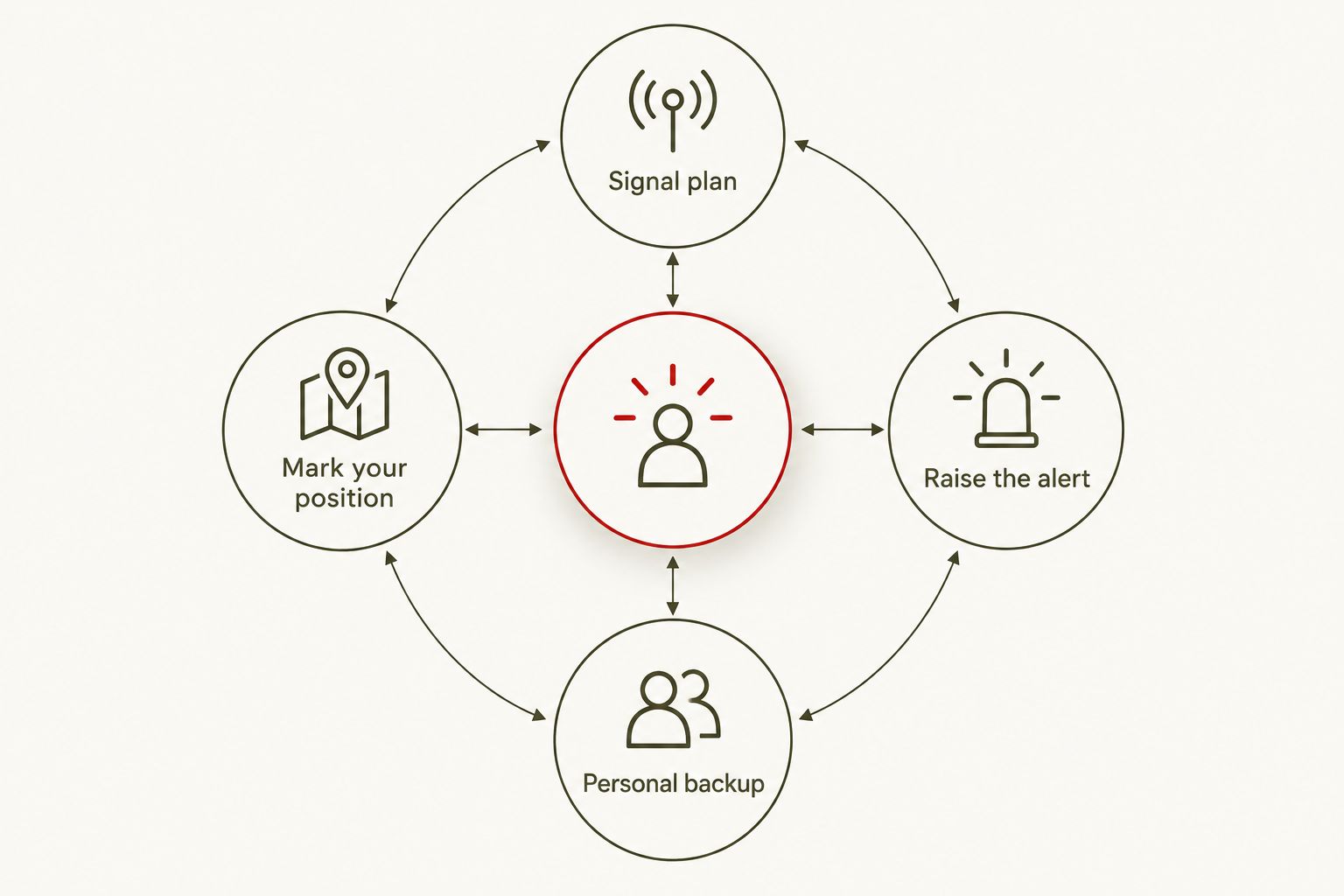
Give each part of the emergency setup a clear role. Use Raise the alert, Mark your position and Personal backup as your crew briefing headings. Keep the distinction simple.
Marine VHF Channel 16, at 156.8 MHz, is the international voice distress, safety and calling channel. Learn the distress procedure before departure. A radio fitted with DSC also needs correct setup and an understanding of its distress function.
In Ireland, call 112 or 999 and ask for the Coast Guard for a maritime emergency when using a phone. Do not rely on mobile coverage as your only communication method. Tell your shore contact your route and expected return, and agree what to do if you are overdue.
Inspect, store and dispose of flares correctly
For your 2026 inspection, read the expiry date on every pyrotechnic device. Check the casing and packaging for damage. Keep the manufacturer's instructions available and make sure the crew knows the storage location.
Use the specified storage conditions. Protect the kit from moisture, heat and accidental activation, without burying it beneath tackle boxes. After a wet trip, inspect the container and its contents according to the instructions.
Do not fire expired flares to test them. Do not put them in household waste or assume a marina, Garda station or rescue station accepts them. Contact the supplier or an authorised disposal service and confirm the arrangement before transporting them.
Which marine safety flares should you choose?
Choose a mixed coastal signal kit as the starting point for coastal boat angling, then check it against your passage and requirements. For offshore trips, select the appropriate package with elevated alerting and close-range location signals. Add personal backup separately.
We recommend making the purchase decision around the boat's emergency plan. Choose the required functions first. Reject any kit you cannot inspect, understand or store safely.
FAQ
What's the best marine safety flares kit for boat fishing in Ireland?
A passage-matched mixed kit is the best starting point for coastal boat fishing. Check its actual signal types, expiry dates and suitability against current Irish guidance and any requirements applying to your vessel.
Are red handheld flares enough for offshore fishing?
Red handheld flares alone do not cover every offshore signalling task. They provide close-range visual identification, while elevated signals, communications equipment and daylight markers serve different roles.
Can an electronic distress light replace marine flares in Ireland?
Do not assume an electronic distress light replaces required pyrotechnic flares in Ireland. Verify the device's acceptance for your vessel and operation before changing the required equipment.
Are orange smoke signals useful at night?
Orange smoke is a daylight position-marking signal, not a night-time solution. Carry suitable signals for the conditions in which your boat operates.
How do I dispose of expired boat flares?
Arrange disposal through a supplier or authorised service that confirms it accepts them. Never fire expired flares for practice, put them in household waste or arrive at a station without an agreed disposal arrangement.
Which VHF channel do I use for a distress call?
Use marine VHF Channel 16 for a voice distress call. Learn the correct procedure before departure and understand the separate DSC distress function if your radio has it.
Should I keep all my signals in the boat's main locker?
Keep the main kit protected and accessible, but carry suitable personal backup where you can reach it. Equipment left aboard cannot help you if you become separated from the boat.
One last thing
Check access while wearing your lifejacket and normal fishing clothing. With the engine off and the boat safely secured, ask another crew member to locate the closed signal kit without moving your tackle. Leave every flare sealed and unactivated; rehearse finding the equipment, not firing it.