

Best Marine VHF Radio 2026: Fixed DSC for Irish Boats
Best overall for a powered coastal fishing boat: a fixed DSC marine VHF radio. Best for a sea-fishing kayak: a floating handheld with GPS and DSC. Best as a separate backup: a floating voice-only handheld. Our 2026 guide ranks these radio types by how you fish around Ireland, not by features you will never use.
- We recommend a fixed DSC marine VHF radio for powered coastal fishing boats in Ireland.
- Choose a floating GPS-and-DSC handheld for sea-kayak fishing, with secure attachment and reachable controls.
- Use a floating voice-only handheld as a separate backup, not a substitute for a properly installed boat radio.
- Marine radio performance depends on antenna height, power, correct setup and your ability to operate it.
Why this matters
A marine VHF radio lets you communicate with nearby vessels and coastal stations. A mobile phone serves a different purpose. Calling one person does not alert nearby boats listening on the radio.
Your radio belongs in the boat's safety setup, not beside the optional extras. Keep communication separate from fish-location equipment; our guide to fishfinders for kayak and boat anglers in Ireland covers that different job.
We recommend a fixed DSC marine VHF radio for anglers using powered coastal fishing boats in Ireland. Pair it with a reachable handheld where your boat and trip warrant a separate backup. Neither radio removes the need for suitable safety equipment, training and a sensible passage plan.
What makes the best marine VHF radio?
Use these criteria for your 2026 shortlist. Start with the boat, then judge the radio.
- Radio format: A fixed unit suits a permanent helm installation. A handheld travels with you and needs no fixed antenna installation.
- Distress calling: Digital Selective Calling, or DSC, sends a digital distress alert when correctly configured. Voice communication remains essential.
- Position source: A DSC radio needs valid position information to include your location in an alert. Check whether GPS is built in or supplied through a compatible connection.
- Water protection: Read the exact ingress rating and its test conditions. Waterproofing and flotation are separate features.
- Power and antenna: A fixed radio relies on the boat's electrical supply and external antenna. A handheld relies on its own battery and smaller antenna.
- Controls and attachment: You need to hear the speaker, find the transmit button and reach the radio while wearing your fishing kit.
Do not confuse a long feature list with a complete installation. A clear screen cannot compensate for a damaged antenna cable. A floating handheld cannot help if it drifts beyond reach.
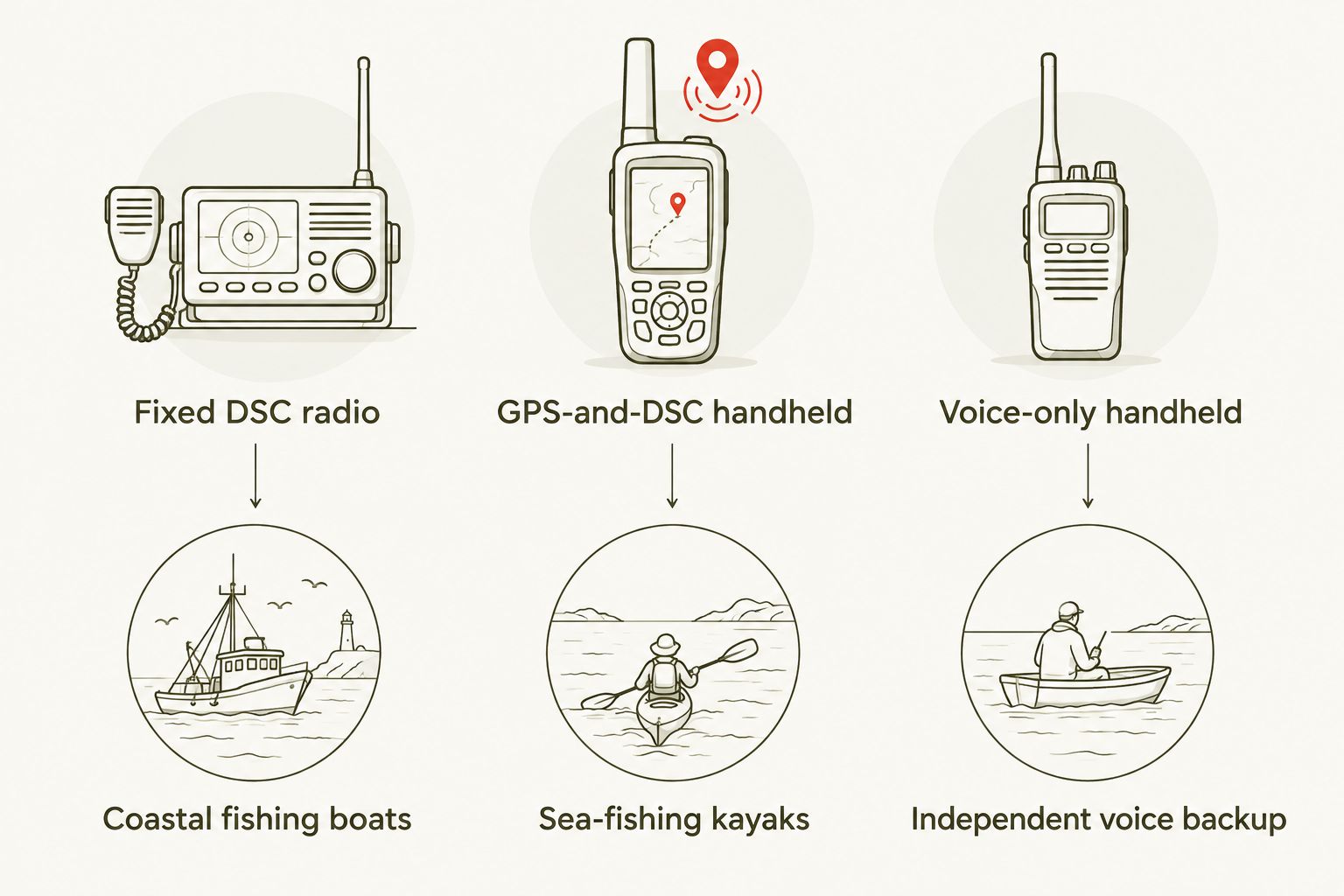
Marine VHF radio options at a glance
| Radio type | Best for | Standout feature | Key limitation |
|---|---|---|---|
| Fixed DSC radio | Powered coastal fishing boats | External antenna and boat-powered operation | Depends on installation and the boat's power supply |
| Floating GPS-and-DSC handheld | Sea-fishing kayaks and portable personal use | Portable distress calling with an internal position source | Smaller antenna and finite battery charge |
| Floating voice-only handheld | Independent voice backup aboard a boat | Simple portable communication on its own battery | No DSC distress alert |
These are equipment categories, not interchangeable recommendations. Choose the fixed unit for the boat's main station, the GPS-and-DSC handheld for personal portable use, and the voice-only handheld for a clearly defined backup role.
1. Fixed DSC radio: best marine VHF radio for coastal boats
A fixed DSC radio mounts aboard your boat and connects to an external marine antenna. It draws power from the boat's electrical system. For a powered fishing boat with room for a proper installation, this is our default recommendation in 2026.
A typical fixed marine VHF provides a high-power setting of 25 W and a low-power setting of 1 W. Those settings do not guarantee a particular range. Antenna height, terrain, installation quality and the receiving station all matter.
DSC adds a digital calling function. With the correct maritime identity and valid position information, a distress alert can identify the station and its location; follow it with the required voice procedure.
Fixed DSC radio pros:
- An external antenna can be mounted higher than a handheld antenna.
- Boat power avoids reliance on a handheld's internal battery alone.
- A permanent helm position keeps the main radio in a predictable place.
- Correctly configured DSC supports digital distress alerting.
Fixed DSC radio cons:
- Installation includes power wiring, antenna placement and cable routing.
- Failure of the connected power supply can disable the radio.
- You cannot carry the fixed unit with you if you leave the boat.
Best for: Anglers using powered coastal boats with a permanent helm and suitable electrical installation.
Check the microphone position before drilling. You should be able to use it without leaning across rods, throttle controls or loose tackle. Keep the speaker audible from your normal operating position.
Verdict: Buy a fixed DSC radio as the main radio for a properly equipped coastal fishing boat.
2. Floating GPS-and-DSC handheld: best for sea-fishing kayaks
A floating GPS-and-DSC handheld combines portable voice communication, a position receiver and digital calling. Choose a model that explicitly lists all three functions. A floating radio does not automatically include GPS or DSC.
This format suits a sea-fishing kayak because the radio can stay with the paddler rather than depend on a permanent helm installation. Reach matters. Put it where you can operate it without opening a rear hatch or reaching through tackle.
For a 2026 sea-kayak setup, check how the handheld attaches to your buoyancy aid or other suitable carrying point. Follow the equipment makers' instructions. Avoid long loose cords that create snagging hazards.
Floating GPS-and-DSC handheld pros:
- Carries voice communication and a position source in one portable unit.
- Operates independently of a boat's electrical supply.
- Flotation provides an opportunity to retrieve a dropped radio.
- DSC adds digital distress alerting when correctly configured.
Floating GPS-and-DSC handheld cons:
- Its low antenna position limits the radio horizon compared with a higher boat antenna.
- Battery charge must cover your planned use.
- Small controls need a practical check with your normal gloves.
Best for: Sea-kayak anglers who need a personal portable radio with GPS and DSC.
Try the carrying position while seated, not just standing in the shop. Check that you can reach the transmit button and see the display. Your paddle stroke and buoyancy aid must still work normally.
Verdict: Buy a floating GPS-and-DSC handheld for personal communication on a sea-fishing kayak.
3. Floating voice-only handheld: best for independent backup
A floating voice-only handheld provides marine voice communication without DSC distress calling. Its separate battery gives it a useful backup role aboard a boat with a fixed radio. Keep it charged and accessible.
This is the simpler option, but simplicity has a clear trade-off. You must communicate your identity, position and situation by voice. The radio does not send a DSC distress alert for you.
Treat the handheld as a separate system. Storing it flat beside the main radio does not provide useful backup if both become inaccessible together.
Floating voice-only handheld pros:
- Works independently of the fixed radio's electrical connection.
- Can travel between boats where lawful operation and licensing allow.
- Provides portable voice communication away from the helm.
Floating voice-only handheld cons:
- Cannot send a DSC distress alert.
- Its portable antenna and battery impose practical limits.
- Flotation does not guarantee that you can retrieve it.
Best for: Boat anglers adding an independent voice backup to an existing fixed DSC installation.
Keep written vessel details and a way to establish your position within reach. Do not assume another crew member knows where the handheld lives or how to select the distress channel.
Verdict: Buy for a defined backup role; skip it as an equivalent replacement for a fixed DSC installation.
How we ranked these radio types
The order follows the buying criteria: installation format, distress calling, position information, water protection, power and usable controls. It is a suitability ranking, not a claim that one radio type performs every job better.
The fixed DSC radio takes the main-station slot for powered coastal boats. The floating GPS-and-DSC handheld takes the personal portable slot. The voice-only handheld takes the independent backup slot.
For your 2026 purchase, judge the exact model against that role. Check its manual rather than assuming every radio in the category has the same functions.
Check these details before buying
Waterproofing and flotation
IPX7 is an ingress-protection classification under IEC 60529. Its temporary immersion test uses specified conditions, commonly described as 1 m depth for 30 minutes. It is not a promise of unlimited immersion or protection against every saltwater exposure.
IPX8 uses immersion conditions specified by the manufacturer. Read those conditions rather than treating the label as a universal depth rating. Neither rating tells you whether the radio floats.
Check whether flotation depends on a particular battery or fitted accessory. Keep covers and seals in the condition required by the manual.
DSC, GPS and maritime identity
DSC is not ready just because the radio has a covered distress button. You need the correct Maritime Mobile Service Identity, or MMSI, and the setup required for that radio. Position information must also be valid.
A fixed radio can have built-in GPS or require position data from another device. Confirm the supported connection before buying. A fishfinder or chartplotter on the same boat does not establish compatibility by itself.
Irish licensing and training
Before operating marine radio equipment in Ireland, check the Department of Transport's current requirements for the appropriate ship radio licence and operator qualification. A fishing licence is not a radio licence.
Complete suitable training and learn the radio's controls before launching. Carrying equipment does not teach you the calling procedure when you need it.
Fit the radio around the way you fish
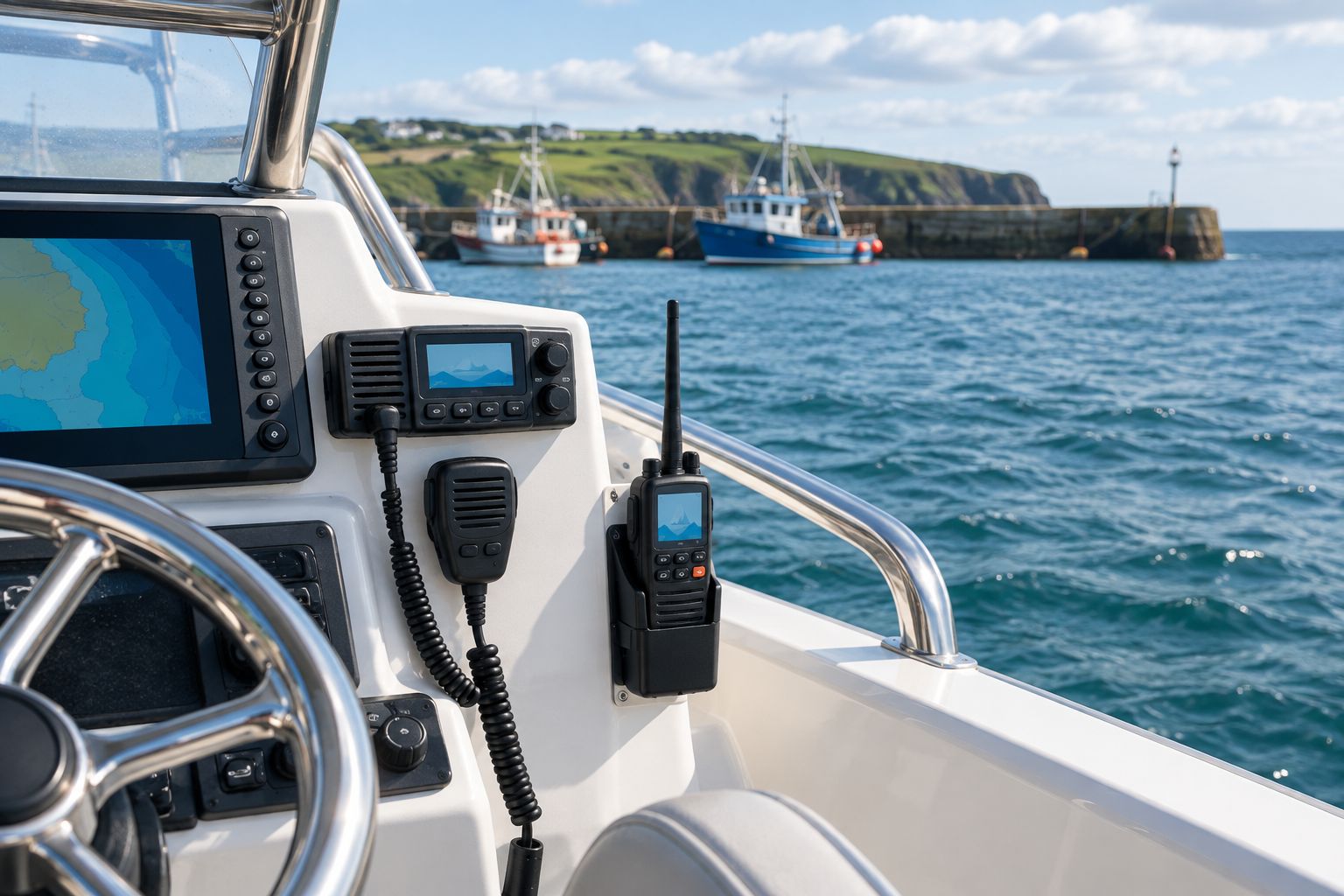
A fixed radio microphone should sit clear of rod handles and moving controls. Its cable should not hang across a walkway. The handheld needs its own reachable carrying position.
Picture the same setup while wearing wet-weather clothing. If a jacket blocks access or a glove prevents button operation, change the position or choose different controls before going afloat.
Use it properly on the water
Marine VHF Channel 16 is used for distress, safety and calling. Channel 70 is reserved for DSC, not voice conversation. Learn the correct working-channel procedure rather than keeping routine conversation on the distress channel.
Do not transmit a live distress alert as a test. Use the manufacturer's permitted test procedure and your training provider's guidance. Make ordinary radio checks through the appropriate local procedure, not by creating unnecessary distress-channel traffic.
Before each trip, check power, antenna connections, handheld charge and displayed position where fitted. Make sure another crew member can find and operate the radio. For a genuine emergency requiring immediate assistance, the Irish Coast Guard can also be contacted by calling 112 or 999 and asking for the Coast Guard.
Which marine VHF radio should you choose?
Choose a fixed DSC radio for your powered coastal fishing boat, then assess a separate handheld backup. That is our default 2026 recommendation. Get the installation and training right before adding extra functions.
For a sea-fishing kayak, choose a floating handheld with GPS and DSC that you can operate from your carrying position. For backup aboard a boat, a floating voice-only handheld has a clear role, provided you understand what it cannot do.
FAQ
What's the best marine VHF radio for boat fishing in Ireland?
A fixed DSC marine VHF radio is the default choice for a powered coastal fishing boat with a suitable installation. Choose a compatible position source, a properly installed external antenna and accessible controls.
Is a handheld marine VHF radio better than a fixed radio?
A handheld is better for personal portability; a fixed radio is better suited to a permanent boat station with an external antenna. Choose by the role rather than treating either format as universally better.
Do I need GPS and DSC on a kayak radio?
We recommend a floating handheld with GPS and DSC for sea-fishing kayaks. GPS supplies position information and DSC supports digital distress alerting, but both require correct setup and competent operation.
Does a waterproof marine radio float?
Waterproofing does not mean flotation. Check the radio's stated flotation feature, immersion rating and any battery or accessory conditions separately.
How far will a marine VHF radio transmit?
There is no single guaranteed transmission distance for a marine VHF radio. Antenna height, surrounding terrain, installation and the receiving station affect communication, so do not base a trip on an advertised maximum range.
Which channel should I use in a marine emergency?
Channel 16 is the marine VHF voice channel for distress and safety. Channel 70 is used for DSC rather than voice; learn the distress procedure through suitable marine radio training.
Do I need a licence to use a marine VHF radio in Ireland?
Check the Department of Transport's requirements for the appropriate ship radio licence and operator qualification before operating in Ireland. Buying a radio does not complete those requirements.
One last thing
Check the handheld where you will actually carry it. Sit at the helm or in the kayak, wear your usual kit and reach for the controls. A radio tucked safely away but out of reach is the wrong setup.