

Marine Batteries for Boats: Best Fit in 2026
Irish electric-outboard and fishfinder anglers' marine battery setup is a deep-cycle power system matched to motor voltage and total load, with the aim of keeping propulsion and sonar stable for the full trip. In 2026, Irish anglers also need to control weight, charging access and wet storage; our fishfinder setup guide for kayaks and small boats covers the screen side while this guide covers battery sizing, chemistry and wiring.
- Marine batteries for boats must match the outboard voltage before capacity or chemistry is considered.
- Calculate demand from each device label instead of guessing runtime from battery size alone.
- LiFePO4 reduces weight and maintains steadier voltage; marine leisure batteries offer a simpler entry point.
- Our 2026 verdict: Ampac 068 12V 70Ah is best for a straightforward 12V marine setup.
Why marine batteries matter for boat anglers
Electric outboards draw power for as long as the propeller turns. Fishfinders, chartplotters and connected transducers add a separate continuous load. A starter battery is designed around short engine-cranking bursts, while a deep-cycle marine or leisure battery is designed for repeated discharge and recharge.
The difference shows up on the water. A voltage drop can reduce electric-outboard performance or cause marine electronics to restart. A battery that is too large adds unnecessary weight, particularly in a kayak or compact aluminium boat. A battery that is too small cuts the session short.
In 2026, the useful buying order is voltage first, required capacity second, chemistry third and physical fit last. We treat the motor voltage as a fixed requirement. Capacity and chemistry can then be adjusted around trip length, boat size and charging routine.
How to choose a marine battery for your setup
Record every electrical load
Start manually. Read the rating label or manual for the electric outboard, fishfinder, chartplotter, transducer module, navigation lights and any USB equipment. Record voltage and current in amps for every device that will run from the battery.
Motor demand changes with the selected thrust setting, so a maximum-current figure does not automatically describe a full day's use. Build the estimate around how you operate the boat, then retain reserve capacity rather than planning to drain the battery completely.
Use this basic calculation: battery amp-hours divided by total current in amps gives an idealised runtime in hours. It is a planning figure, not a promise. Temperature, wiring losses, battery age, motor setting and the manufacturer's discharge limits change the result.
- Photograph every equipment label before comparing batteries
- List each device and its required voltage
- Record current draw from the device manual
- Estimate how long each device will run
- Separate essential loads from optional accessories
Match the battery voltage to the motor
A 12V motor needs a 12V supply. A 24V motor needs a 24V supply. Connecting the wrong voltage risks equipment damage or prevents the motor from operating correctly.
Two matching 12V batteries wired in series create a 24V bank. Batteries connected in series need the same chemistry, capacity, age and state of charge. A single 24V 100Ah LiFePO4 battery removes the need to pair separate 12V units; its supplied specification lists 2,560Wh of energy.
Do not connect a 12V-only fishfinder directly to a 24V motor circuit. Use a suitable separate 12V supply or a correctly specified voltage converter where the electronics manufacturer permits one.
- Copy the motor's rated voltage exactly
- Confirm the fishfinder input-voltage range separately
- Use matched batteries when building a series bank
- Check connector polarity before switching on
- Keep 12V-only equipment off an unconverted 24V circuit
Choose the battery chemistry
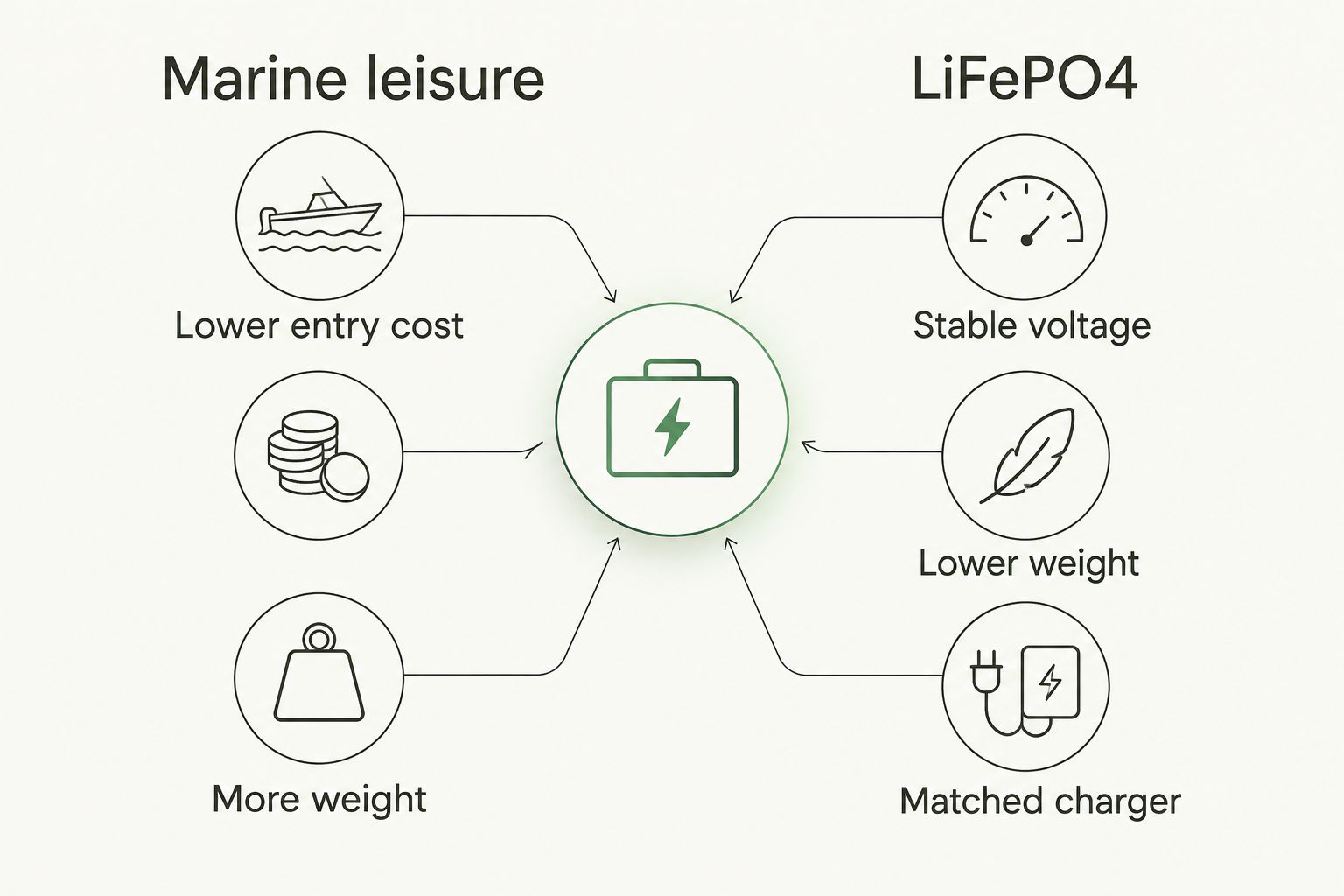
Marine leisure batteries and LiFePO4 batteries solve the same basic problem in different ways. A conventional leisure battery offers lower entry cost and familiar charging equipment. Its disadvantages are more weight, greater voltage drop through discharge and stricter attention to storage charge.
LiFePO4 offers lower weight, stable voltage and deeper usable discharge when its battery-management system and manufacturer permit it. It needs a matched charger, and the battery's continuous-current rating must support the outboard's demand.
The 12V 70Ah Ampac marine battery, 85 amp Ampac marine battery and 12.8V 80Ah Green Cell LiFePO4 battery show the main choices available for 2026 boat setups. We recommend comparing their voltage and capacity against the equipment labels before choosing between them.


Use the equipment manual as the final check. A battery can have the correct voltage and capacity but still lack the discharge rating required by a high-current motor.
- Best for a simple 12V setup: Ampac 068 12V 70Ah
- Best for LiFePO4 chemistry: Green Cell 12.8V 80Ah
- Best for a larger listed marine capacity: Ampac Marine Battery 85 amp
- Confirm continuous-current limits before connecting an outboard
- Use a charger approved for the selected chemistry
Separate the motor and electronics circuits
A fishfinder does not always need a separate battery, but it benefits from a dedicated fused circuit. Electric motors create changing loads, and poor shared wiring can produce voltage drop or electrical interference at the display.
Run correctly sized marine cable from the battery or distribution point. Place circuit protection according to the equipment manufacturer's instructions. Keep high-current motor wiring separate from sensitive transducer and display cables where the installation allows it.
A battery box protects exposed terminals and keeps the battery secured. It does not make an unsafe electrical connection safe, and it does not replace correctly rated fuses, cable or connectors.
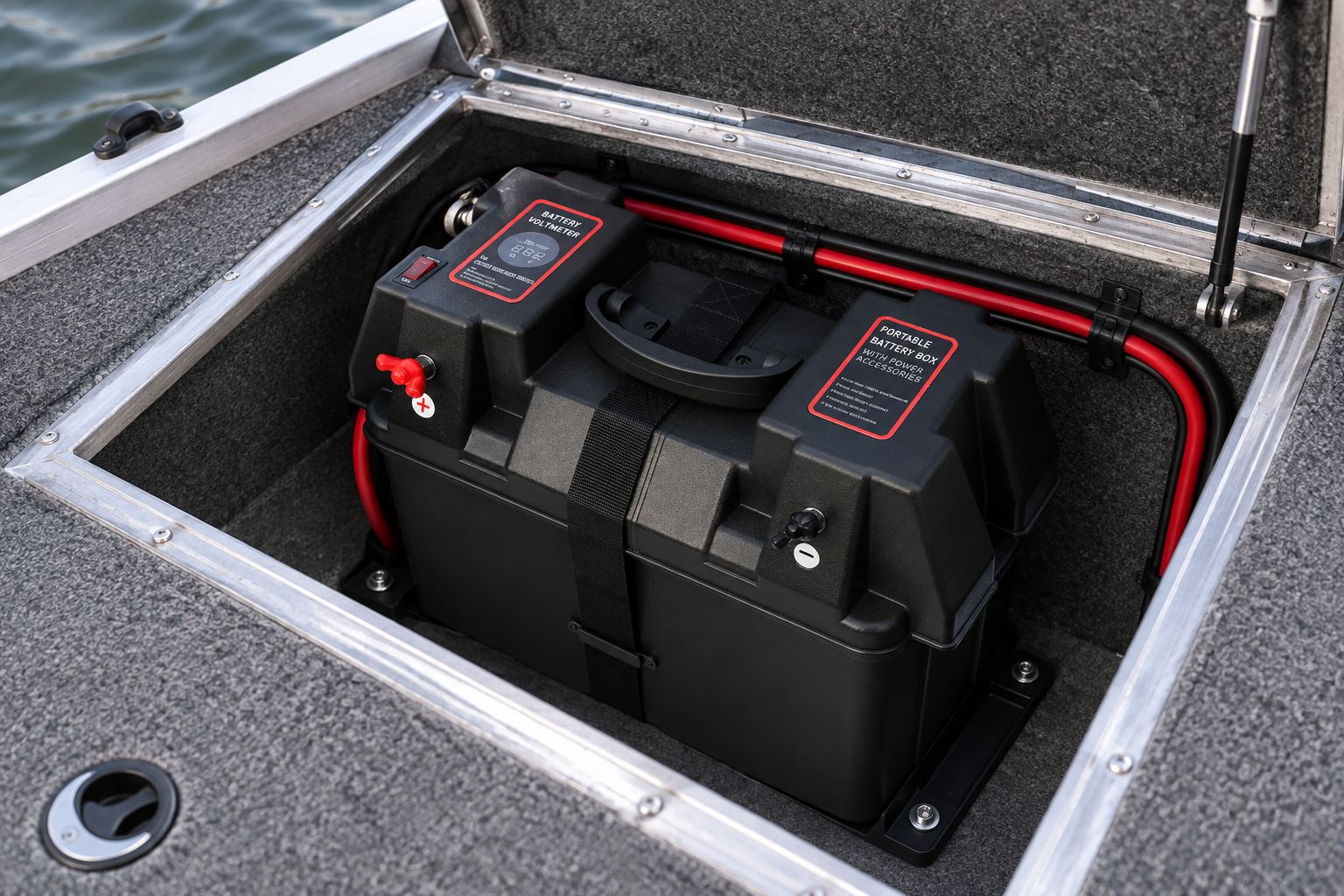
Check the wiring before launching rather than troubleshooting on an Irish lake. We recommend labelling each circuit at both ends so a loose fishfinder connection is easy to distinguish from a motor fault.
- Give the fishfinder its own fused branch circuit
- Size cable for current, length and manufacturer guidance
- Keep motor and transducer cables separated where practical
- Cover exposed positive terminals
- Secure every battery against movement
Calculate usable capacity and reserve
Amp-hours only compare batteries properly when their voltages match. Watt-hours provide a better energy comparison across different voltages: multiply nominal voltage by amp-hours.
A 12V 70Ah battery contains 840Wh of nominal energy. A 12.8V 80Ah battery contains 1,024Wh of nominal energy. These figures describe stored energy before discharge limits, conversion losses and operating conditions are considered.
For a 2026 boat setup, calculate runtime from the manufacturer's current figures and the battery's permitted usable capacity. Do not plan a trip around the final fraction of charge. Reserve is required for wind, current, route changes and a longer return to the slip.
- Convert voltage and amp-hours into watt-hours
- Use the manufacturer's permitted discharge limit
- Base motor demand on the settings you actually use
- Include fishfinder and navigation-light demand
- Recalculate after adding any powered accessory
Choose the correct charger
The charger must match battery voltage and chemistry. A charger intended for a conventional lead-acid battery does not automatically suit LiFePO4, and the reverse is also true.
Check the battery manual for the approved charging profile, maximum charging current and storage instructions. Charging time depends on discharged capacity, charger output and the final charging phase. A larger output number is not better when it exceeds the battery manufacturer's limit.
Charging is also part of trip planning. A battery that cannot be restored before the next launch is the wrong practical choice, even when its capacity looks sufficient on paper.
- Match charger voltage to battery voltage
- Select the correct chemistry mode
- Check the permitted charging-current range
- Inspect charging leads and connectors
- Follow the stated storage-charge procedure
Inspect the system before launching
Irish rain, spray and road vibration expose weak connections quickly. Inspect the battery case, terminals, straps, fuse holders and cable insulation before each launch. Replace damaged components rather than covering a split or loose connection temporarily.
Turn on the fishfinder and motor while the boat is still accessible. Confirm that the display remains stable when the motor runs and that no cable or terminal becomes hot. Stop immediately if a connection heats up.
- Check the case for swelling, cracks or leaks
- Tighten and cover battery terminals
- Confirm the retaining strap cannot move
- Inspect cables for cuts and abrasion
- Test motor and fishfinder operation together
Battery options compared for 2026 boat setups
| Option | Best for | Main advantage | Key limitation |
|---|---|---|---|
| Ampac 068 Marine Leisure Battery, 12V 70Ah | Straightforward 12V marine systems | Voltage and capacity are clearly stated | Lower listed capacity than the 80Ah and 85 amp options |
| Ampac Leisure Marine Battery, 85 amp | Larger boat applications | Higher listed capacity than the 70Ah Ampac | Confirm voltage and charger requirements before pairing |
| Green Cell LiFePO4, 12.8V 80Ah | Anglers prioritising LiFePO4 chemistry | Stable lithium voltage and lower category weight | Requires a LiFePO4-compatible charger |
| PowerPack LiFePO4, 24V 100Ah | Motors requiring a 24V supply | Single-battery 24V configuration | Not suitable for equipment restricted to 12V |
| Marine Battery Box Storage | Protecting and organising a battery installation | Covers and contains the battery | Adds no battery capacity |
Our 2026 verdict: the Ampac 068 Marine Leisure Battery is best for a simple 12V, 70Ah setup, while the Green Cell 12.8V 80Ah battery is best for anglers choosing LiFePO4 chemistry. Confirm the outboard's current requirement before treating either option as compatible.
Common mistakes electric-outboard anglers make
- Choosing amp-hours before voltage. Capacity cannot correct a voltage mismatch between the battery and motor.
- Comparing amp-hours across different voltages. Use watt-hours when comparing a 12V system with a 24V system.
- Sharing poor wiring between motor and display. A dedicated fused fishfinder circuit reduces voltage-drop and interference problems.
- Using the wrong charger profile. Match the charger to the battery chemistry and nominal voltage.
- Leaving the battery loose. A battery needs a secure box or restraint that prevents movement inside the boat.
FAQ
What is the best marine battery for boats with a 12V outboard?
The Ampac 068 Marine Leisure Battery is the clearest fit here for a straightforward 12V, 70Ah setup in 2026. Compatibility still depends on the outboard's current requirement and the expected running time.
Is a LiFePO4 battery better for an electric outboard?
LiFePO4 is better when lower weight, stable discharge voltage and repeated cycling are priorities. It requires a compatible charger and a continuous-current rating that supports the motor.
What size battery do I need for a fishfinder and electric outboard?
Choose the motor voltage first, then calculate capacity from the current draw and operating time of both devices. Add reserve and follow the battery manufacturer's usable-discharge limit.
Can I run a fishfinder from the trolling-motor battery?
Yes, if the voltage is compatible and the fishfinder has a correctly protected circuit. A dedicated fused branch reduces problems caused by voltage drop and electrical interference.
Can I connect a 12V fishfinder to a 24V battery?
No, not unless the fishfinder supports that input voltage or an approved converter supplies the required voltage. Direct connection can damage 12V-only equipment.
Do I need a separate battery for marine electronics?
A separate battery is not always required, but it isolates sensitive electronics from changing motor loads. A shared battery still needs separate protection and correctly sized wiring.
How should I store a marine battery between fishing trips?
Store it secured, dry and according to the manufacturer's charge instructions. The correct storage state and charging routine depend on whether the battery is conventional lead-acid or LiFePO4.
One last thing
Amp-hours do not tell the full story when voltages differ. A 12V 70Ah battery contains 840Wh nominally, while a 12.8V 80Ah battery contains 1,024Wh. That watt-hour comparison is more useful than looking at 70Ah versus 80Ah alone.
For a 2026 purchase, photograph the motor and fishfinder labels before shopping. Those two images prevent the most expensive mistake: buying a battery with an attractive capacity that does not match the equipment voltage.