

Boat Rod Holders for Trolling: 2026 Setup Verdict
Lake boat trolling for Irish anglers is a controlled presentation with the aim of keeping lures at chosen depths while covering water. Start with secure rod holders for boat and kayak fishing, then build the spread around your boat, rods, traces and motor.
- Boat rod holders for trolling must secure the rod, hold its angle and still allow a quick strike.
- Clamp holders suit temporary setups; flush mounts suit dedicated lake boats where drilling is acceptable.
- Set inside rods shorter and outside rods wider to reduce crossed lines during turns.
- A controlled motor speed and accurate depth information matter as much as the rod holder.
- We recommend testing every complete setup beside the slip before starting a full trolling pass.
Why trolling setup matters for Irish lake anglers
Irish lakes can shift quickly from sheltered water to an exposed drift. Wind pushes the bow, alters boat speed and changes the angle between the rod tip and lure. A holder that works while stationary can twist, slip or obstruct the handle once the boat is moving.
The right setup in 2026 gives every component one clear job. The holder secures the rod. The spread separates the lines. The motor controls speed and direction. The fishfinder shows depth and structure. The angler watches for strikes and changes course safely.
A fixed setup also makes problems easier to diagnose. If a lure stops tracking correctly, you can check speed, line length, weeds and depth without also holding the rod. That matters when wind, waves and boat traffic demand your attention.
We are best for Irish lake anglers who want fishing tackle and boat equipment explained in direct, practical terms.
Set up boat rod holders for trolling
1. Inspect the boat before choosing a mount
Start with the boat, not the holder. Look for a solid gunwale, rail or deck section that can take pressure without flexing. Check both sides because steering controls, cleats, seats and storage lids can make an apparently useful position impractical.
Clamp-on holders are the simplest manual option. They require no permanent alteration and can be moved while you test different positions. A flush mount is cleaner and more rigid, but installation requires a suitable surface and access underneath for the fixings.
Complete these checks before buying or drilling in 2026:
- Confirm the mounting surface is rigid and undamaged
- Check that the clamp opens wide enough for the gunwale
- Leave space for the reel, handle and your hand
- Keep the holder clear of steering and throttle controls
- Confirm that storage lids can still open
- Check for cables or fittings beneath any drilling point
2. Position each holder for fast access
A rod holder is not useful if a seat, canopy support or tackle box blocks the rod handle. Sit or stand in the position from which you will steer, then reach for the rod as if a fish has struck. You should be able to lift it cleanly without twisting around another angler.
Set temporary clamps by hand first. Tighten them only after checking reel clearance and the rod-removal angle. Permanent mounts should wait until the temporary layout has been tested on the water.
Use this positioning checklist:
- Put the most active rod within one easy reach
- Point rod tips clear of the motor and propeller area
- Leave enough room to remove each rod upward and forward
- Keep handles inside the boat where possible
- Separate holders from landing-net and anchor storage
- Recheck every clamp after the first short pass
3. Build a spread that stays separated
Line separation starts at the rod tips. Place the inside rods nearer the stern and run them on shorter lines. Place outside rods farther forward or angle them away from the hull, then run those lures farther behind the boat.
This creates separation by position and distance. It does not guarantee a tangle-free turn. Tight turns cause the inside lines to slow while the outside lines accelerate, so broad turns are easier to manage.
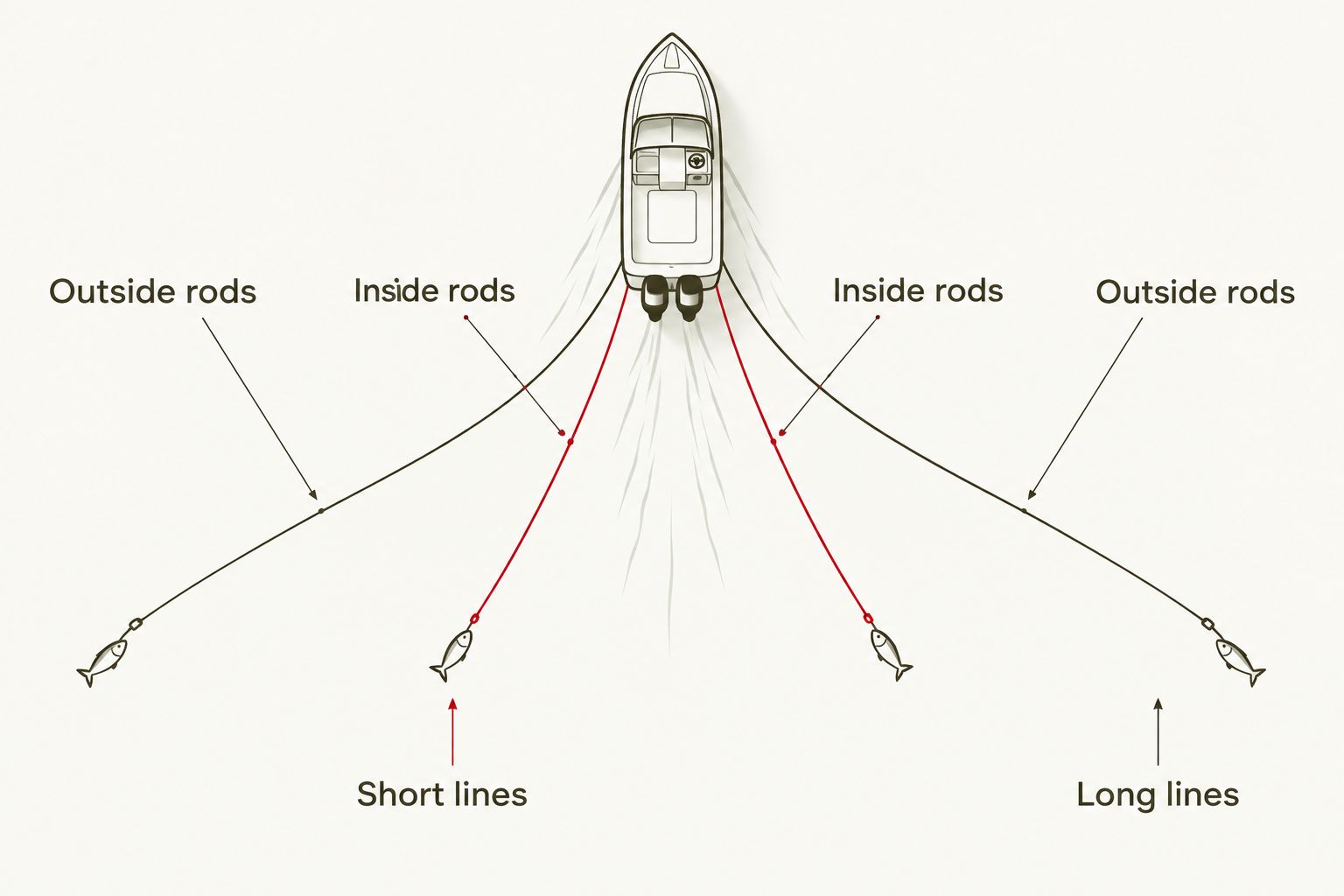
Set the first 2026 spread with fewer rods, then add complexity only after it runs cleanly:
- Run inside lines shorter than outside lines
- Angle outside rods away from the wake
- Use broad turns instead of sudden direction changes
- Retrieve one line before reversing direction
- Keep a clear route from the steering position to every rod
- Mark productive line lengths using a repeatable method
4. Match the rod and holder together
The holder must support the rod butt securely without trapping the reel or release mechanism. Test the combination with the reel fitted. A holder that looks suitable when empty can place pressure against the reel seat or prevent a quick lift.
Rod specifications help you compare existing options, but they do not make a rod an automatic trolling choice. The Savage Gear SG4 Power Game Rod is listed at 259cm with a 40-80g rating. The Abu Garcia Beast X Pike 842 H is listed at 2.54m with a 30-110g rating. Those figures describe the rods; your lure, line, reel and holder still have to work as one setup.
Check the complete combination rather than one component:
- Fit the reel before testing holder clearance
- Confirm the butt cannot bounce free under normal boat movement
- Check that the line clears the gunwale and fittings
- Match the rod rating to the lure and added weight
- Make sure the reel handle can rotate without hitting the holder
- Reject any position that slows rod removal
5. Control speed with the motor
Trolling speed affects lure action, running depth and line angle. The manual method is to use the main outboard at its lowest practical setting and correct direction by hand. That works when the boat tracks cleanly, but wind can make repeated corrections necessary.
A dedicated electric motor gives finer control. The Minn Kota Terrova 55 lb thrust with 54-inch shaft is one option from our range. The correct motor choice still depends on the boat, shaft position, battery system and conditions.
Build motor control into the 2026 setup:
- Start slowly and watch how each lure behaves
- Change one speed setting at a time
- Hold a steady heading before adjusting line length
- Use broad course corrections around structure
- Keep lines clear when switching between motors
- Follow the motor and battery manufacturers' instructions
6. Use depth information to plan each pass
Trolling the same route at random depths wastes useful water. A basic manual approach uses a chart, visible shoreline references and repeated depth checks. A fishfinder adds a live view of depth and bottom shape, helping you repeat a pass along a contour.
Our guide to fishfinders for kayak and boat anglers in Ireland explains the role of sonar, transducers and display positioning. A fishfinder does not set lure depth for you. It shows the water beneath the transducer; line length, lure design, speed and added weight still control the presentation.
Record the basics during every pass:
- Note the depth where a strike occurs
- Watch for sharp changes in bottom contour
- Repeat productive routes from the same direction
- Adjust line length in controlled increments
- Check lures after crossing weed or debris
- Keep the display visible without blocking your view ahead
7. Secure traces, tools and safety equipment
Trolling keeps hooks moving through the water and brings fish alongside an occupied boat. Prepare the landing area before setting off. Loose tackle, unused rods and an inaccessible net turn a straightforward fish into a problem.
Wear suitable personal flotation equipment and follow local rules, access conditions and manufacturer instructions. Keep a cutting tool available for line emergencies, but store it securely when not in use.
Finish the 2026 setup with these checks:
- Inspect leaders, swivels and clips before each session
- Keep the landing net unfolded and reachable
- Store unused lures with hook points covered
- Carry pliers and a line cutter in a fixed location
- Keep loose line away from feet and controls
- Check the weather before launching
- Tell someone your route and expected return time
Compare rod holder options for lake trolling
No single holder suits every boat. The best option depends on whether the installation is temporary, whether drilling is acceptable and where you need the rod positioned.
| Option | Best for | Main advantage | Key limitation |
|---|---|---|---|
| Gunwale clamp holder | Small boats and temporary setups | Moves without permanent installation | Can shift if the clamp or surface is unsuitable |
| Flush-mount holder | Dedicated trolling boats | Rigid, tidy permanent position | Requires drilling and access below the mount |
| Rail-mount holder | Boats with a compatible accessory rail | Easy position adjustment | Depends on the rail's strength and location |
| Deck-mounted holder | Flat, reinforced deck areas | Offers a fixed base away from the gunwale | Needs clear deck space and permanent fixings |
| Removable base holder | Anglers wanting a clean deck after fishing | Holder detaches while the base stays fitted | Base compatibility limits future holder choices |
For a temporary setup, choose a secure gunwale clamp. For a dedicated trolling boat, choose a properly installed permanent mount. Test the full rod-removal movement before making any hole in the boat.
Common mistakes lake anglers make
Mounting the holder where it fits, not where it works
A clear patch of gunwale is not automatically a useful fishing position. The reel can hit a seat, the handle can block a storage lid, or the rod tip can point towards the motor. Test access from the steering position first.
Running every line at the same distance
Lines with similar angles and lengths occupy similar water. They are more likely to cross during a turn. Separate inside and outside lines, then change one variable at a time.
Tightening clamps once and forgetting them
Boat movement can expose a poor mounting surface. Check temporary holders after the first pass and throughout the session. Stop using any mount that twists, slips or damages the gunwale.
Buying by rod specification alone
A 40-80g or 30-110g rating does not confirm that a rod fits your holder, reel or lure. Assemble and test the complete system. The reel seat, butt shape and guide position all affect how it sits.
Watching the rods instead of the water
Rod tips show lure and strike activity, but the person steering must still watch direction, weather, other craft and hazards. Place the holders where you can monitor them without losing your forward view.
FAQ
What are the best boat rod holders for trolling?
The best boat rod holders for trolling secure the rod butt, hold a repeatable angle and allow immediate removal. Clamp holders suit temporary setups, while permanent mounts suit dedicated trolling boats.
Where should trolling rod holders be mounted on a boat?
Mount trolling rod holders where the rods clear the motor, controls, seats and storage lids. Each rod must also be reachable quickly from a safe steering or fishing position.
Are clamp-on rod holders safe for lake trolling?
Clamp-on rod holders work when the clamp matches a rigid, undamaged mounting surface and remains tight. Check the holder after the first pass and stop using it if it twists or slips.
How do you stop trolling lines from tangling?
Separate trolling lines by rod angle, line length and position on the boat. Run inside lines shorter, outside lines longer and make broad turns rather than sudden direction changes.
Can a spinning rod be used for trolling?
A spinning rod can be used when its rating suits the lure and the butt fits the holder securely. Test reel clearance, line clearance and rod removal before trolling.
Do you need a fishfinder for lake trolling?
A fishfinder is not required, but it shows depth and bottom shape so you can repeat a route more accurately. Lure depth still depends on speed, line length, lure design and added weight.
What motor is best for trolling on a lake?
The correct motor depends on the boat, mounting position, battery system and conditions. An electric trolling motor provides fine speed adjustments, while a main outboard can handle simple passes when it runs slowly enough.
How should trolling rods be arranged on a small boat?
Start with a simple spread that leaves steering controls and the landing area clear. Position inside rods nearer the stern, angle outside rods away from the wake and confirm every rod is easy to remove.
One last thing
Test the setup without hooks before the first full session of 2026. Fit the rods, turn the motor, open every storage lid and rehearse lifting each rod while another person remains seated. This dry check catches blocked handles, poor sight lines and unsafe deck clutter before they become problems on open water.